
What Probate Covers in Kent County
The Kent County Probate Court holds statutory jurisdiction over incapacitated or mentally ill individuals, their assets, and the transfer of assets at death. In plain terms, it is the court that handles what happens to a person's estate when they die and who steps in to help when someone can no longer manage their own affairs. That mission spans wills, decedent estates, guardianships, conservatorships, and the letters of authority that name the people responsible for carrying out those roles.
Because the court centers on protection and property, its files answer very practical questions. Who was appointed to manage a relative's finances. Whether a will was admitted and who serves as personal representative. Whether a guardian has authority over a vulnerable adult. These records are created as cases move through the court, and most of them are open to the public unless a statute, court rule, or judge's order makes them nonpublic.
The court's own overview page explains this role in detail. A lead-in worth reading is the Probate Court role and statutory-jurisdiction overview, which lays out the categories of matters the bench hears.
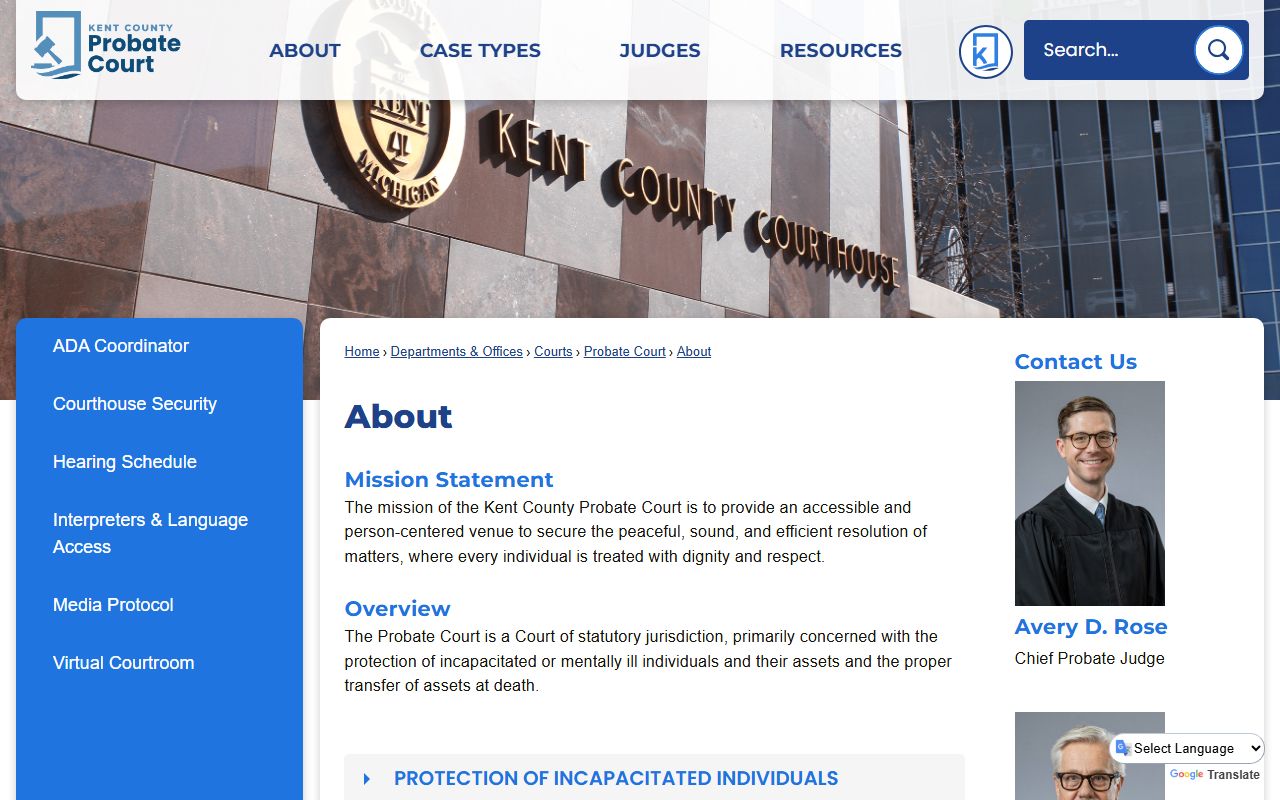
The page confirms that estate administration, protective proceedings, and mental-health matters all fall under one probate umbrella in Kent County, which is why a single search often surfaces several linked case types.
Kent County Probate Court Location and Hours
The Probate Court sits inside the downtown courthouse cluster on Ottawa Avenue, on the same block as the circuit court and clerk offices. Counter filings run on a tighter window than the court's full business day, so plan an in-person visit for the mid-day hours rather than right at open or close.
Kent County Probate Court
180 Ottawa Avenue NW, Suite 2500
Grand Rapids, MI 49503
Phone: 616-632-5440
Fax: 616-632-5430
Mon-Fri, 8:00 a.m. to 5:00 p.m.
Counter filings 9:00 a.m. to 4:00 p.m.
For directions, staff contacts, and current notices, the official Probate Court contact and hours page is the authoritative source.
The contact page lists the same Suite 2500 address and phone shown above, so it is a reliable double-check before you file a document or request a copy in person.
Probate Terms Defined
Probate files carry a set of terms that appear again and again on petitions, orders, and letters. Knowing them makes a case record far easier to read and helps you ask the counter clerk for the right document.
- Testator
- The person who made a will. When the testator dies, the will is offered to the Probate Court for admission.
- Executor
- The individual named in a will to carry out its terms. In Michigan this role is commonly titled personal representative.
- Intestate
- Dying without a valid will. The estate is then distributed under Michigan's default succession rules rather than the deceased person's written wishes.
- Guardianship
- A protective arrangement giving one person legal authority to make personal and care decisions for a minor or an incapacitated adult, called the ward.
- Conservatorship
- A protective arrangement giving one person authority to manage the money, property, and financial affairs of a protected individual.
- Letter of Authority
- The court-issued document proving a personal representative, guardian, or conservator is legally empowered to act on behalf of an estate or protected person.
How to Search Kent County Probate Records
The fastest starting point is the county probate name search, which lets the public look up cases by the ward or party name. It is the front door for confirming that a case exists and pulling its number before you request copies or visit the counter. The county also keeps a resources page that gathers the search tool, forms, the fee schedule, an inventory fee calculator, and the letters and orders copy request in one place.
- Open the county probate name search landing page and read the access terms before you begin.
- Enter the ward's last and first name, then narrow the results with the case type and, if you have it, the case number.
- Note the matching case number, then use the letters and orders copy request or visit the counter for certified documents the search does not display.
When you need more than a case lookup, the bundled hub is the efficient route. The Probate Court resources page links the name search, fee schedule, forms, informational meetings, the inventory fee calculator, the letters and orders copy request, and local administrative orders together.
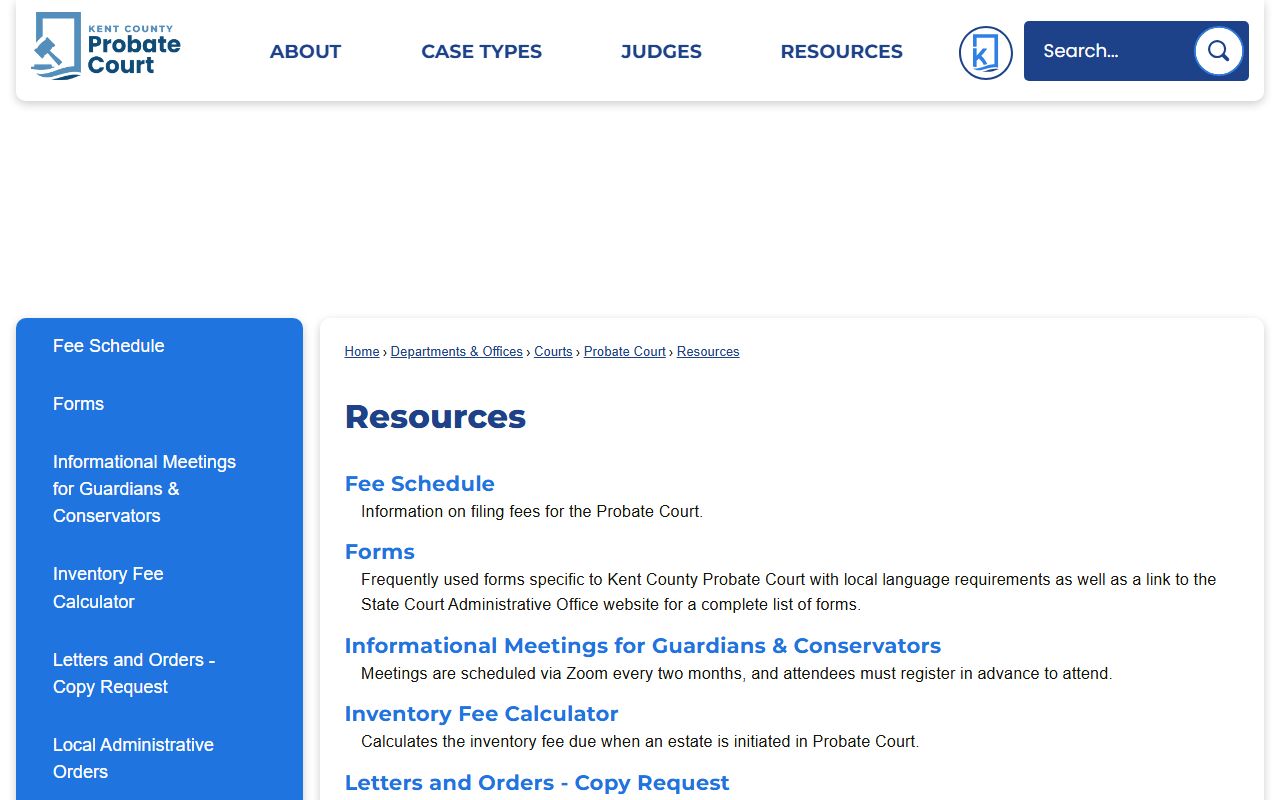
Bookmarking that hub saves clicks, since it collects every probate self-service tool the county publishes without hunting through separate menus.
Note: The probate name search is a partly online, partly counter-based system, so some documents can be viewed remotely while others are released only by copy request or at the courthouse.
Probate Name Search Fields
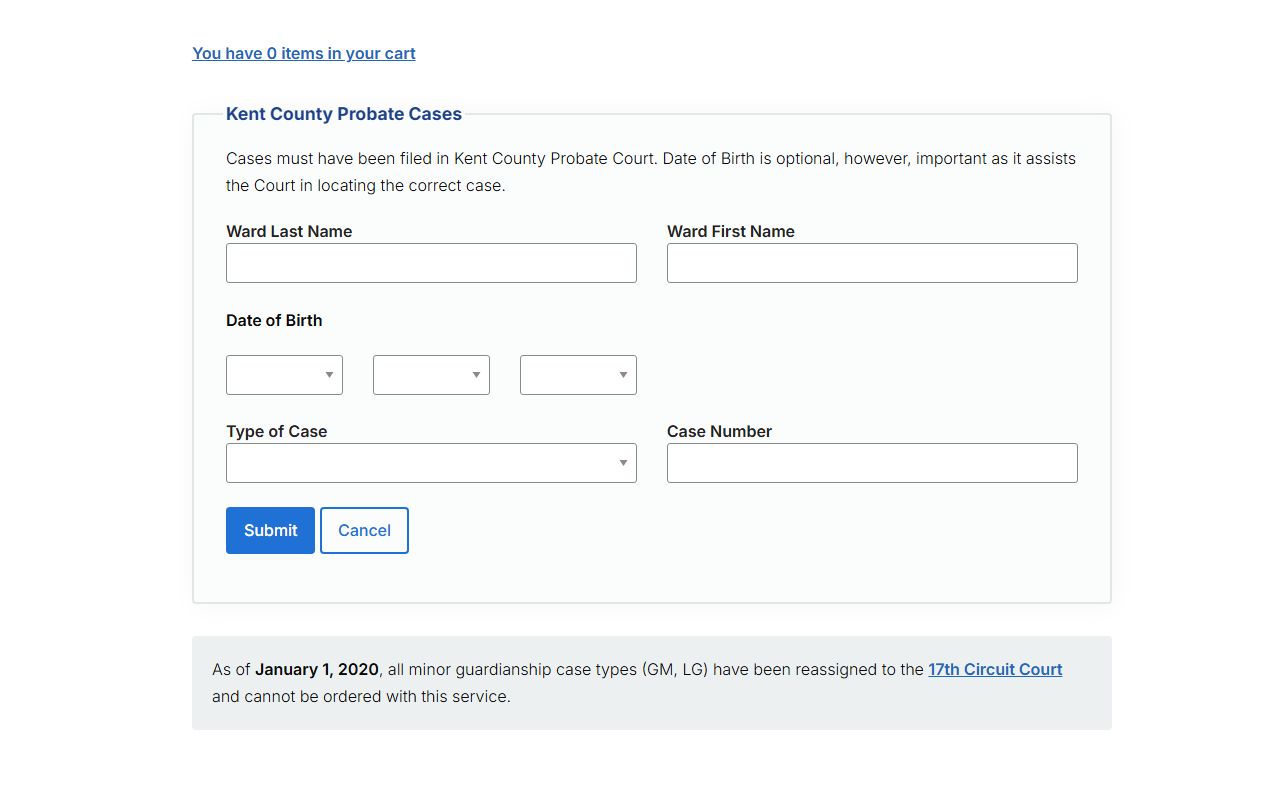
The name search form is built around the ward's identity. Two fields are required, the ward's last name and first name, and a case-type selection is also required so the system knows which category of matter to return. Date-of-birth dropdowns and the case number are optional, but adding them trims a common name down to the right record quickly.
| Field Label | Type | Required | Notes |
|---|---|---|---|
| Ward Last Name | Text | Yes | Primary search field. |
| Ward First Name | Text | Yes | Primary search field. |
| Date of Birth (Month / Day / Year) | Dropdown | No | Optional but helpful for common names. |
| Type of Case | Dropdown | Yes | Includes CA, CY, DD, GA, GL, DA, and DE case types. |
| Case Number | Text | No | Optional; narrows straight to one file. |
The form is introduced on the county's own landing page, which explains the search rules before you run a query. The probate name search landing page is the place to start every lookup.
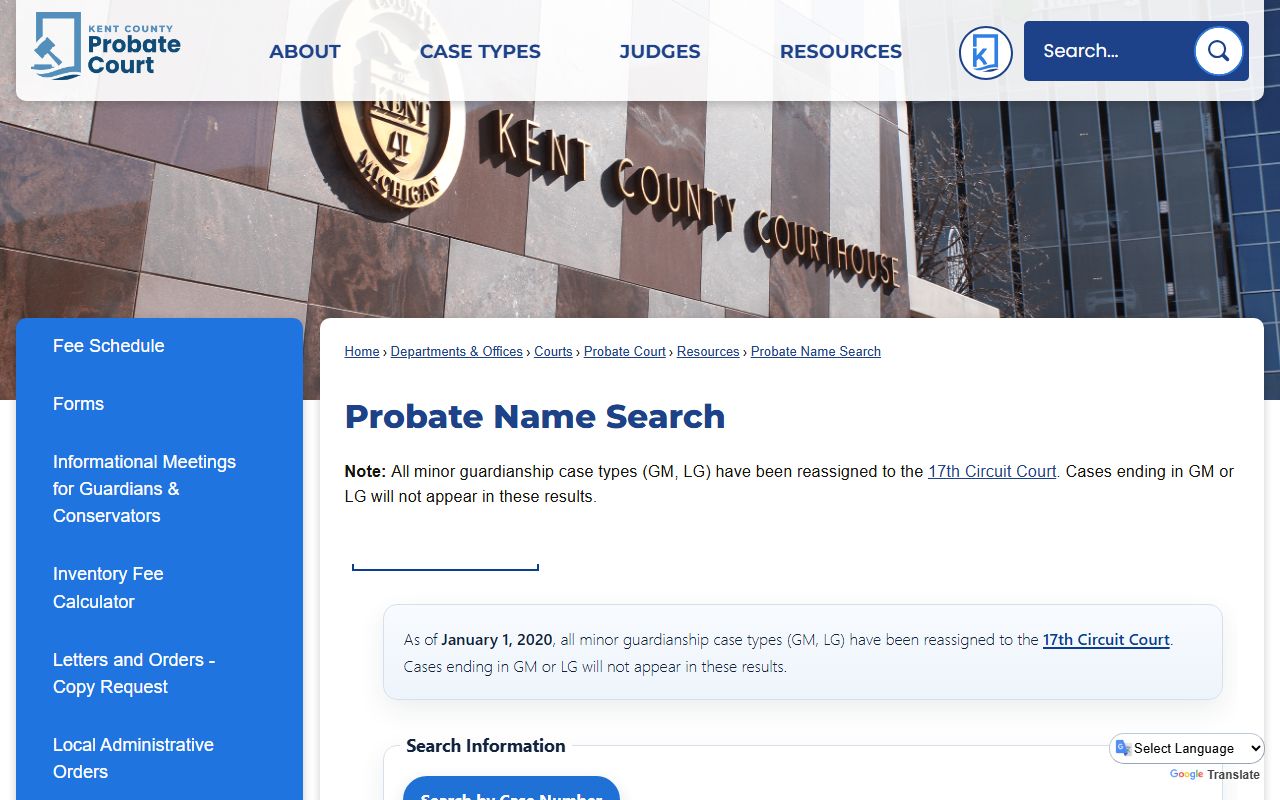
Matching the fields above to what you see on that landing page keeps a search from stalling on a missing required entry.
Probate Case-Type Codes
The Type of Case dropdown is not a single bucket. It separates probate matters into distinct code categories so a search returns the correct kind of file, whether that is a guardianship, a conservatorship, or a decedent estate. Choosing the right code is part of why the system asks for it as a required field.
- CA
- CY
- DD
- GA
- GL
- DA
- DE
The county distinguishes conservatorship, guardianship, and decedent-estate authority rather than lumping them into one file type, which is why the letters a court issues also come in matching flavors. Selecting the wrong code is the most common reason a valid name turns up no results, so try a second code if the first search comes back empty.
Probate Letters and Certified Copies
Current letters can be ordered online through the county's certified-record portal. The portal sells current letters for a conservatorship, a guardianship, or the personal representative of a decedent estate, and each order is processed and shipped within about five business days. One rule catches people off guard at checkout: probate records and circuit court records cannot be ordered in the same session, so an estate copy and a divorce judgment need two separate orders.
| Item | Amount |
|---|---|
| Current probate letters (per copy) | $12 |
| Research fee if the record cannot be located | $6 |
The research fee applies when the office must search for a record that cannot be found from the name or system data supplied, often because of a spelling difference or because the case is not in the system. To place an order, open the probate letters request form, which walks through the same ward and case details the name search uses.
You can reach the ordering tool directly through the county's probate letters request form, which is part of the same certified-record system used for divorce judgment copies handled through the county's marriage and divorce records.
Guardianship vs Conservatorship
These two protective proceedings sound alike and often involve the same family, but they cover different ground. A guardianship is about the person. It gives the guardian authority over care, housing, and personal and medical decisions for a minor or an incapacitated adult, who is called the ward. A conservatorship is about the money. It gives the conservator authority to manage the finances, income, and property of a protected individual.
One person can hold both roles, or the court can split them between two people. That is why a single family situation can produce more than one probate case and more than one letter of authority. When you search, matching the case type to the authority you are checking keeps the results clean.
One county-specific shift matters here. As of January 1, 2020, minor guardianship case types moved to the Circuit Court, so newer minor guardianship matters may be tracked in the circuit system rather than the probate name search.
Mental-Health Petitions
Mental-health matters are among the most sensitive files the Probate Court handles, and they carry statutory confidentiality that ordinary estate files do not. Because these cases involve a person's treatment and civil liberties, access is more limited than a typical public case, and the court routes them through a dedicated process.
The county's mental-health page is the starting point for anyone who needs to file. It states that Network 180 is the contact point for petitions involving individuals who are not already hospitalized, which sends the request to the community-mental-health system rather than directly to the courthouse counter.
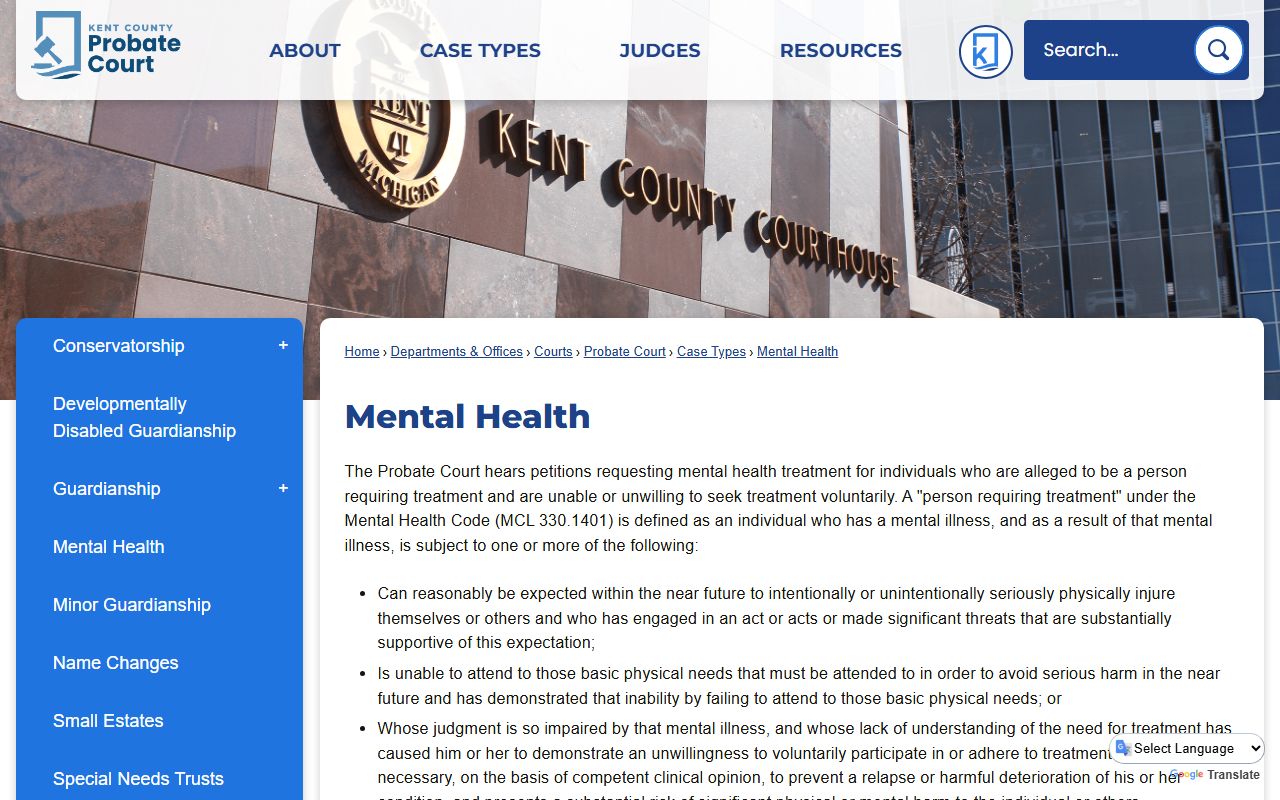
The mental-health petition page explains which path to use and reflects the confidentiality that keeps most of these records out of ordinary public view.
Access Limits on Probate Records
Kent County follows the Michigan court rules on open and protected records. The working rule is straightforward: public case records are open unless a statute, court rule, or judge's order makes them nonpublic. Michigan also requires public filings to leave out protected personal identifying information, so some data is redacted rather than the whole file being sealed.
Several probate-adjacent categories are more restricted than a standard estate file. Mental-health proceedings are usually more limited because they are filed through the Probate Court and carry statutory confidentiality. Minor guardianship records and adoption matters are handled separately from ordinary public files, and sealed records are available only by court order or other authorized access. Personal details such as dates of birth and account numbers are commonly redacted from what the public can view.
For estate matters that never became a court case, or for the underlying vital and marriage documents that support an estate, the broader county court records system and the clerk's vital-records desk cover ground the probate name search does not.