
Michigan's Trial Court Structure in Kent County
Michigan keeps a clean trial-court structure compared with states that split their clerks and courts many ways. The trial courts are the Circuit Courts, the District Courts, and the Probate Courts. When a party appeals a trial-court ruling, the case moves up to the Michigan Court of Appeals and then, if review is granted, to the Michigan Supreme Court. Kent County fits that model with one major Circuit Court, five District Court venues, and a Probate Court inside the downtown courthouse complex.
The Circuit Court is the workhorse for the county's higher-level cases. It hears higher-value civil disputes, family matters, and felony criminal charges. District courts are local trial courts rather than a separate county-court system, and they handle the smaller and faster-moving files. Probate Court is distinct enough that Kent County publishes its own probate contact page, resources page, name search, and letters-copy request flow. That three-court split is the reason a single case type can start in one court and finish in another.
The 17th Circuit Court in Kent County
The 17th Circuit Court is the centerpiece of the county's higher trial-court work, and it operates out of the downtown Kent County Courthouse. Its public tools tell the story: hearing schedules, motion calendars, a judges roster, online payments, and eFiling. The courthouse is the base for records access and for the interpreter and accessibility requests the court publishes alongside its case tools.
The building runs on standard county hours, and the Circuit Court Clerk sits on the second floor of the same address. Anyone planning a counter visit or a phone call should keep both the landing line and the case-information line handy, because the two lines route to different desks.
17th Circuit Court
Kent County Courthouse
180 Ottawa Avenue NW, Suite 2400
Grand Rapids, MI 49503
Landing phone: 616-632-5220
Case information: 616-632-5480
Hours: Mon-Fri, 8:00 a.m. to 5:00 p.m.
Hearing schedules and motion calendars are posted through the court's online tools, and the same set of listings feeds the wider county docket views collected on the Kent County court dockets page. The clerk's office is the keeper of the records for Circuit Court lawsuits, and case files are public records open for inspection at the counter, though staff cannot give legal advice.
Circuit Court vs District Court vs Probate Court
Michigan's three trial courts divide work by case size and case type, not by geography alone. The Circuit Court takes the serious criminal charges and the larger civil and family files. The District Court takes the everyday volume, including the first steps of a felony case. The Probate Court handles estates and protective proceedings. The table below lays out how the three courts compare on the points readers ask about most.
| Circuit Court | District Court | Probate Court | |
|---|---|---|---|
| What they hear | Felonies, higher civil disputes, family-division matters, and appeals from certain lower rulings | Misdemeanors, arraignments, bail, preliminary exams, small claims, and landlord-tenant cases | Estates, wills, guardianships, conservatorships, and mental-health petitions |
| Civil scope | Higher-value civil matters above the district-court dollar limit | Civil cases up to the published district-court dollar limit, plus small claims | Estate, trust, and protective-proceeding matters |
| Criminal scope | Felony criminal cases and felony sentencing | Misdemeanors, arraignments, and felony preliminary exams before bind-over | None |
| Family cases | Yes, including divorce, custody, support, and personal-protection matters | No | Limited, though minor-guardianship case types moved to Circuit Court in 2020 |
The most useful takeaway is that a felony can appear in both a district court and the Circuit Court over its life. It starts with an arraignment and preliminary exam in District Court, then binds over to the Circuit Court for the trial phase. Divorce and other family files, by contrast, sit in the Circuit Court from the start.
Kent County District Court Venues
Kent County runs five district-court venues rather than one central district court. The county courts page lists the 59th District Court in Walker and Grandville, the 61st District Court in Grand Rapids, the 62-A District Court in Wyoming, the 62-B District Court in Kentwood, and the 63rd District Court, which covers Cedar Springs, East Grand Rapids, Lowell, Rockford, Casnovia Village, and a long list of townships. That is why district-court research needs venue-by-venue detail rather than a single address.
| Court | Cities / Area Served | What It Handles | Location |
|---|---|---|---|
| 59th District Court | Walker and Grandville | Misdemeanors, civil infractions, small claims, and local district cases | Walker and Grandville |
| 61st District Court | City of Grand Rapids | District cases arising in the City of Grand Rapids | 180 Ottawa Avenue NW, Grand Rapids |
| 62-A District Court | City of Wyoming | District cases arising in the City of Wyoming | Wyoming |
| 62-B District Court | City of Kentwood | District cases arising in the City of Kentwood | Kentwood |
| 63rd District Court | Cedar Springs, East Grand Rapids, Lowell, Rockford, Casnovia Village, and townships | Misdemeanors, traffic, and civil infractions across the northern and eastern county | 1950 E Beltline Ave NE, Grand Rapids, MI 49525 |
The county's 63rd District Court contact page lists the Beltline address and the case types this venue handles.
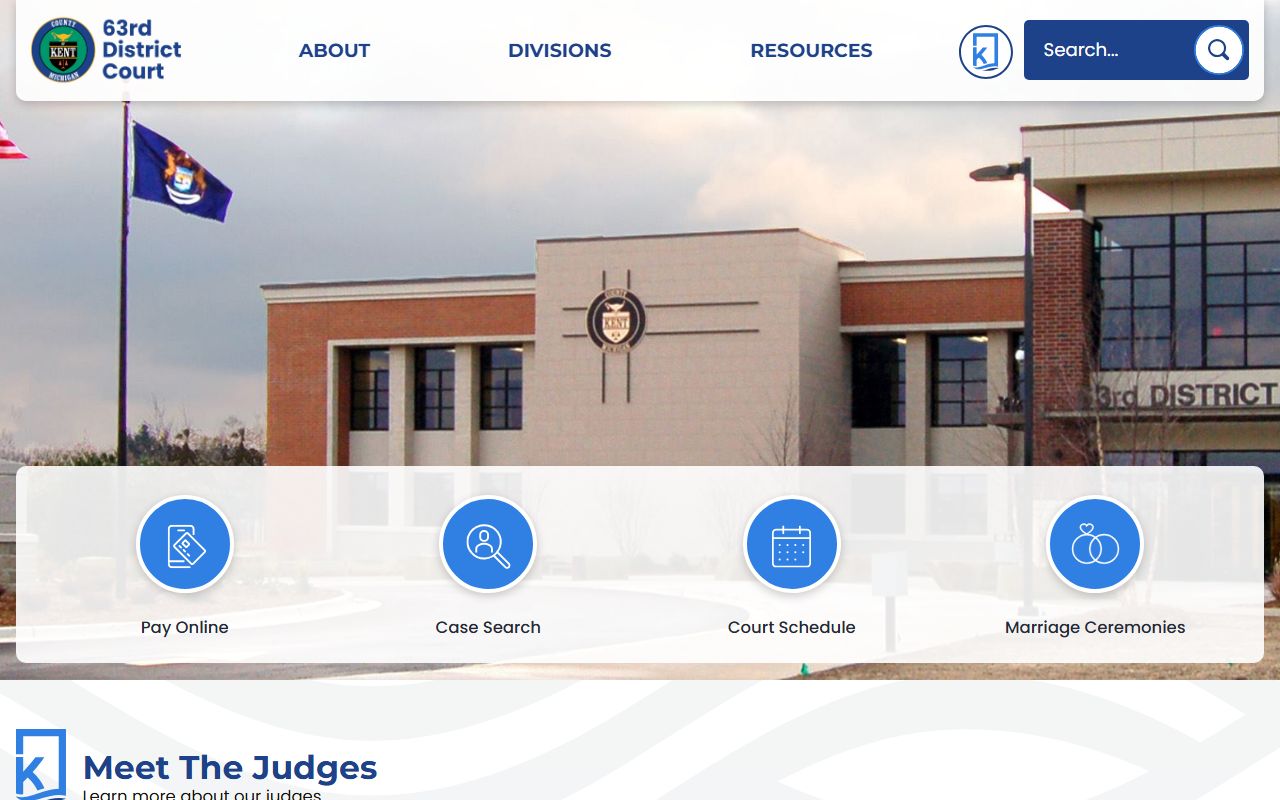
Because the 63rd reaches across small towns and townships, its docket mixes rural traffic tickets with suburban misdemeanor files, and the Beltline location keeps that caseload separate from the downtown courthouse.
Walker publishes its own 59th District Court page for residents on the west side of the county.
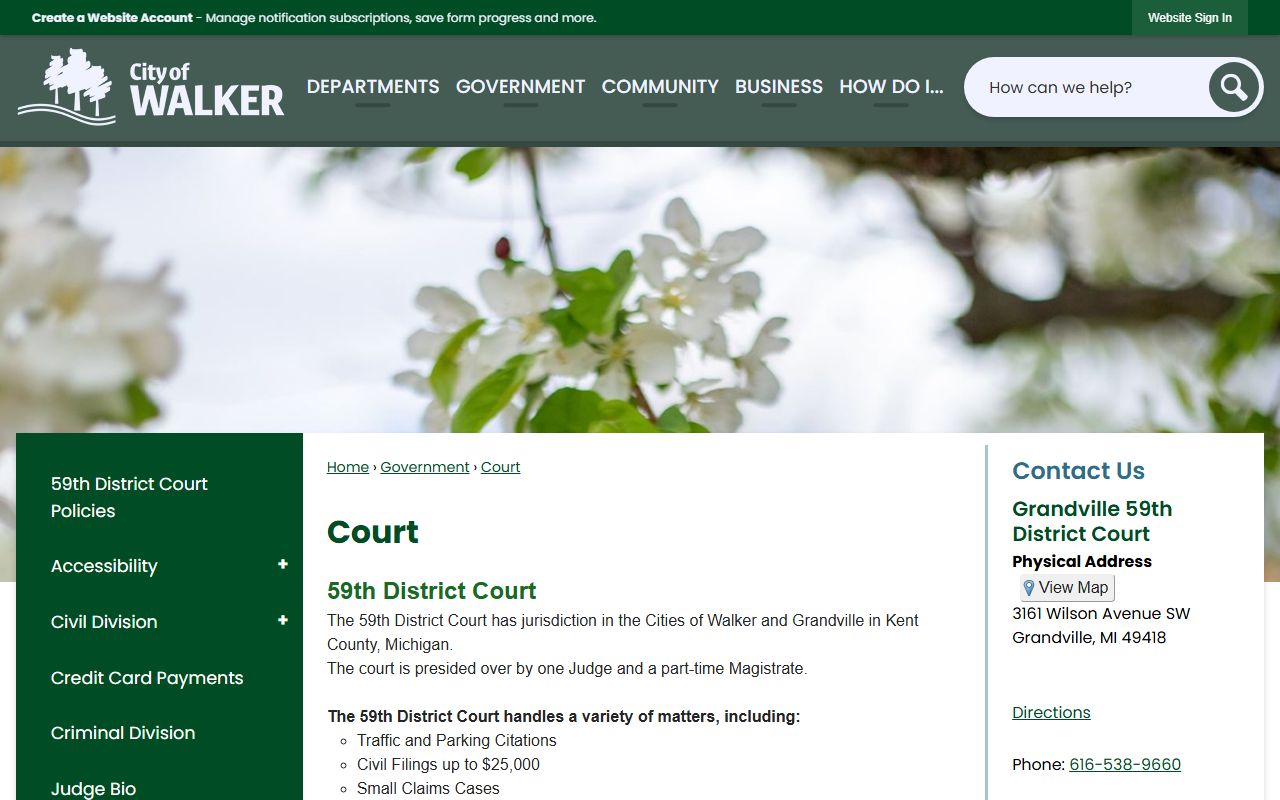
The 59th splits its caseload between Walker and Grandville, so a filing can be tied to either city depending on where the underlying incident happened. Readers checking a west-side matter should confirm which of the two cities the case is docketed under.
Searching Kent County District Court Records
The district courts do not share one universal search box. Each venue points to its own case tool, and the fastest path is almost always the case number. When a name is common, adding a date of birth narrows the result. The county also reminds searchers that a broad background check without a case number or party name is limited and should route through the Michigan State Police or the Department of State.
The City of Wyoming hosts the 62-A District Court, which routes public case searches through the statewide MiCOURT system.
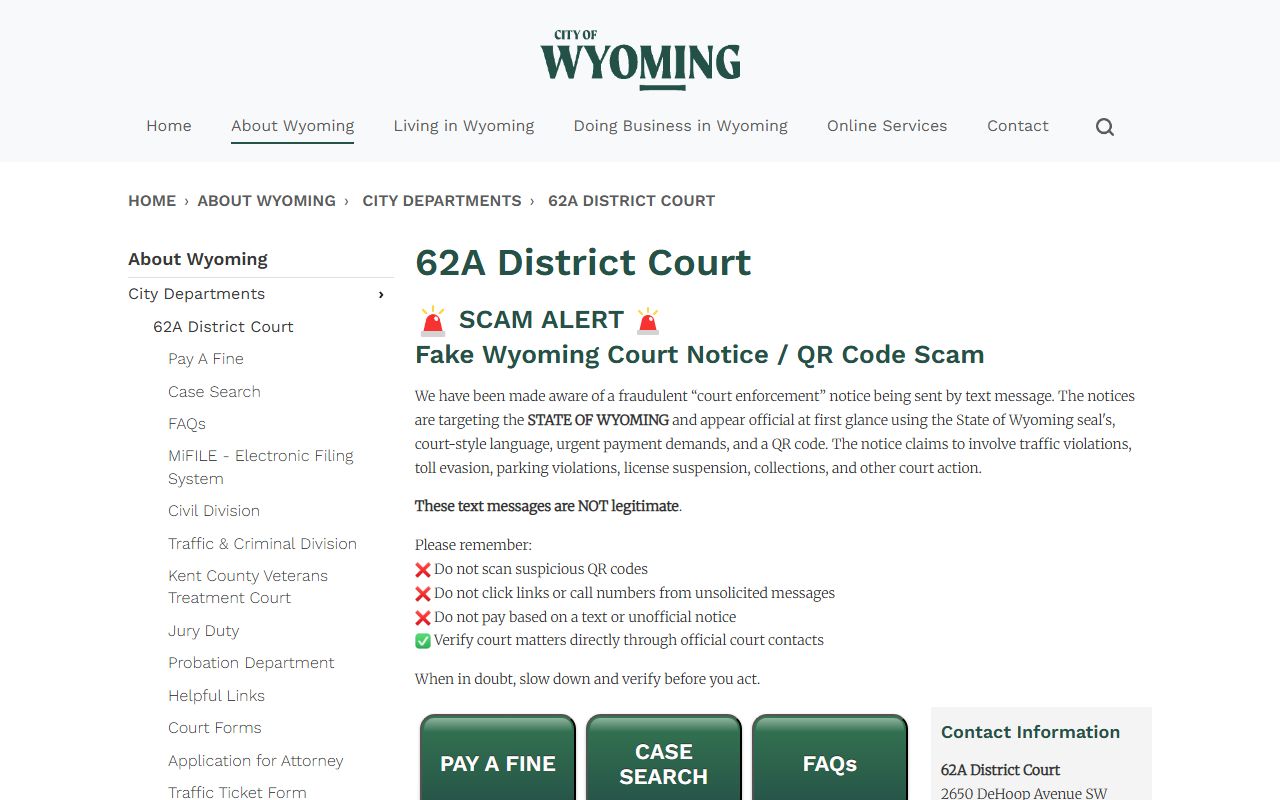
Its register of actions reaches back to 1990, so older Wyoming district files stay searchable by case number or name, while non-public records never appear in the public view.
Kentwood keeps the 62-B District Court department page as the front door for the city's district cases.
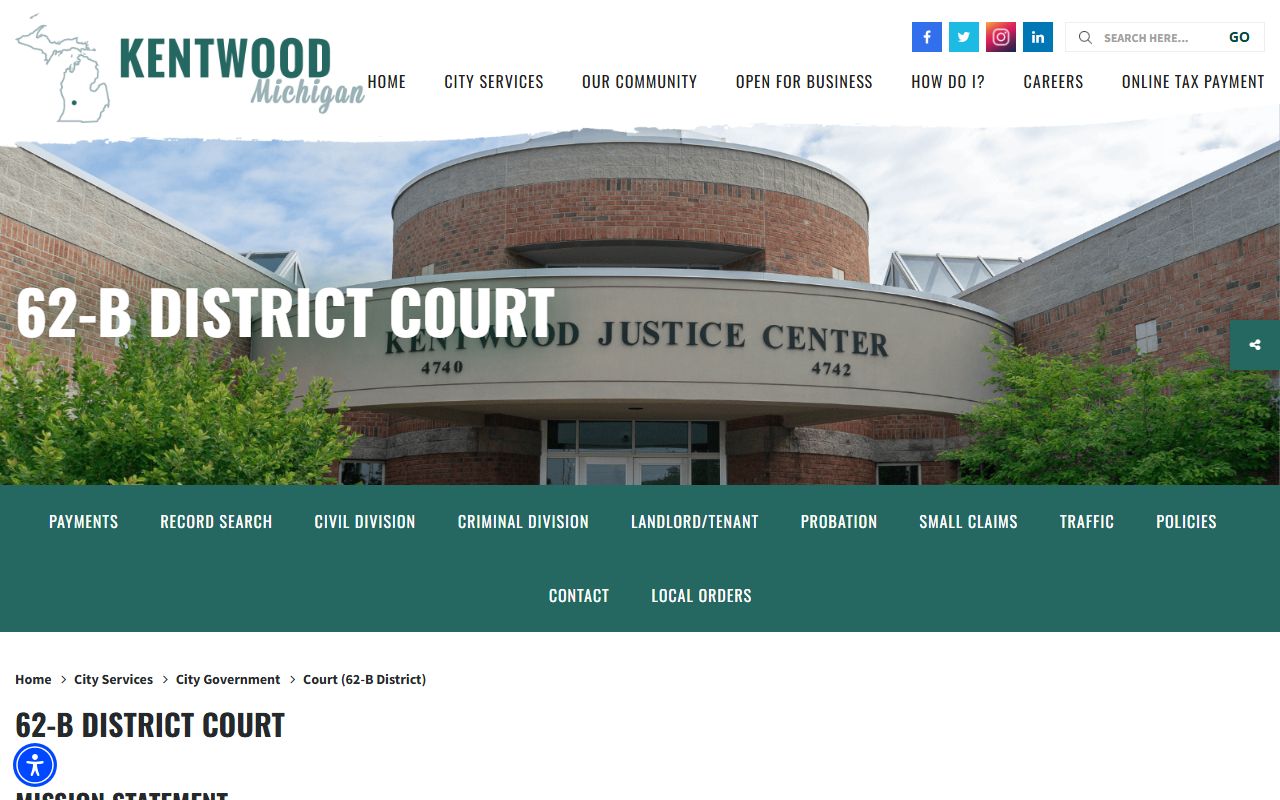
The 62-B is the most search-friendly venue in the county. Its public case grid shows case number, status, party name, date of birth, and attorney, and each row can be expanded for case detail.
The court's own record-search guidance explains how to run a public case check in Kentwood.
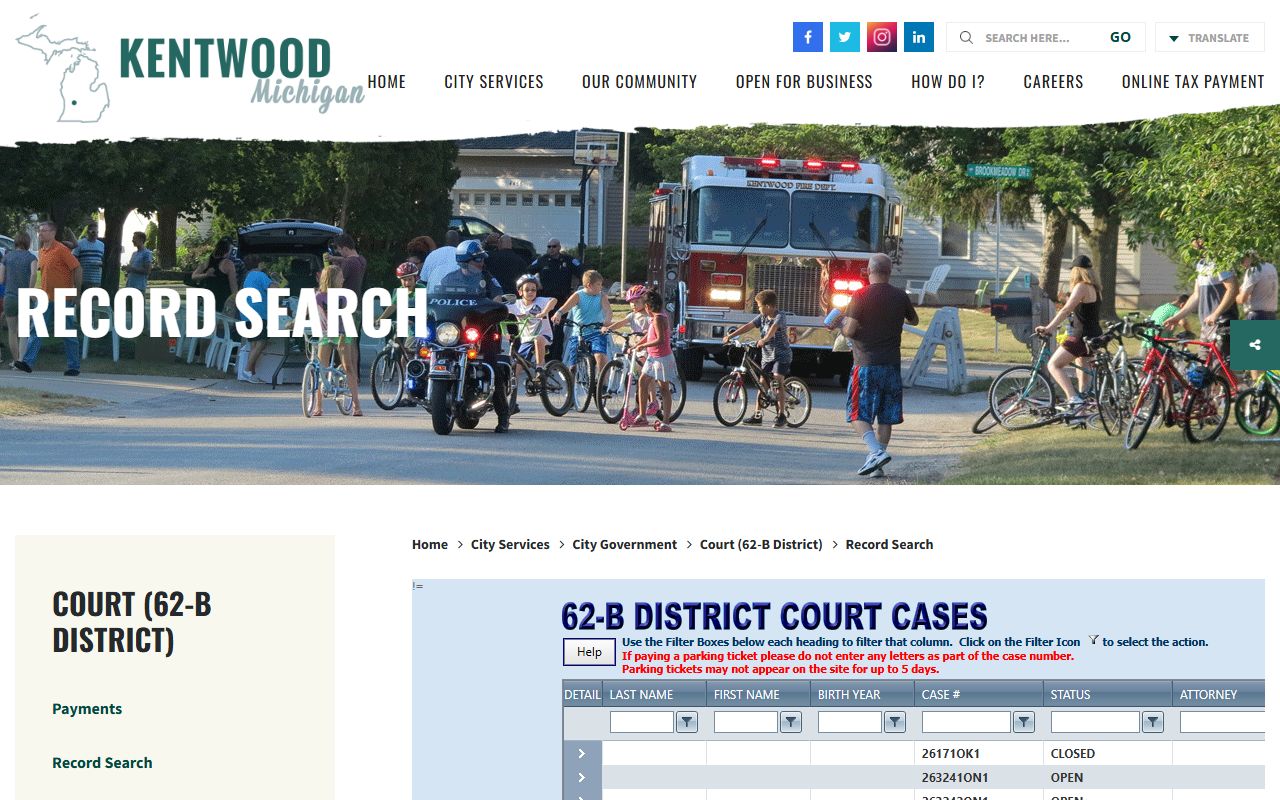
It tells searchers to start with the case number, then add a date of birth when a name is common, and it sends broader criminal-history checks to the state systems. A separate 62-B contact page publishes the court's mailing address, fax line, and email.
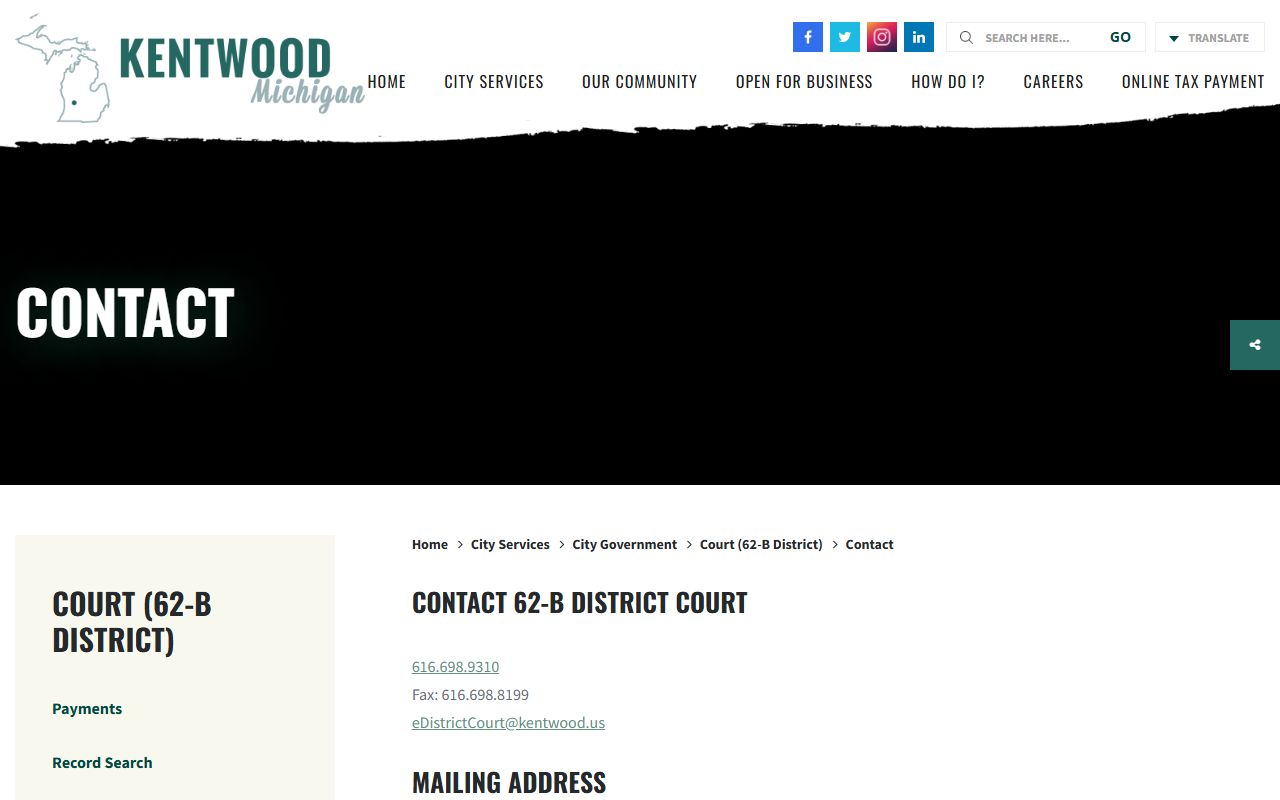
Those channels matter when a filer needs to deliver documents the online grid cannot accept, or when a record request has to go in writing rather than through the case search.
Note: Recent filings may not post to a public portal right away, so a very new district-court case can be missing from an online search for a short time.
How a Case Moves Through the Kent County System
Criminal and civil cases follow different tracks, and knowing the track tells a reader which court holds the file at each stage. A felony starts in a district court and finishes in the Circuit Court. A civil dispute above the district-court limit stays in the Circuit Court from filing through judgment. The two flows below trace the common path for each.
Criminal flow: Arrest › District Court arraignment / preliminary exam › Bound over to Circuit Court › Circuit Court arraignment › Pretrial › Trial › Sentencing › Michigan Court of Appeals
Civil flow: Complaint filed › Answer › Discovery › Motions › Pretrial or mediation › Trial › Judgment › Michigan Court of Appeals
The district-court criminal steps carry local detail. At the 63rd District Court, the misdemeanor workflow covers pleas of guilty, no contest, and standing mute, and it flags that charges carrying 93 days or more require booking through the county jail for fingerprints and photographs. That booking step is one reason a name can show up on the jail viewer even while the case is still in district court.
Civil, Family, and Criminal Divisions
The 17th Circuit Court organizes its work into civil, family, and criminal divisions. The civil division handles the higher-value complaints, answers, motions, orders, and judgments that exceed the district-court dollar limit. The criminal division handles felony charges once a case binds over from the district level, along with felony sentencing. The family division carries divorce, custody, child support, and personal-protection matters, and it also took on minor-guardianship case types that moved from Probate Court in 2020.
District courts staff their own civil and criminal calendars for the lower-dollar and misdemeanor volume, including small claims and landlord-tenant filings. Probate Court runs its estate, guardianship, conservatorship, and mental-health calendars separately. Because divorce judgments are Circuit Court records, certified copies of those judgments come through the circuit-record order flow rather than the district courts.
Specialty and Problem-Solving Courts
Kent County runs a real specialty-court ecosystem, not just a single drug-court label. These problem-solving courts explain why some records move on a different track than an ordinary criminal case, because participants are managed by a team that blends the court with treatment and supervision.
- Treatment and Support Court (TASC): an adult problem-solving court led by Judge J. Joseph Rossi for people with co-occurring substance-use and mental-health needs in the criminal system.
- Juvenile Treatment and Support Court (JTASC): a juvenile treatment court led by Judge Deborah McNabb, aimed at youth stability and better school outcomes.
- Sobriety Court: serves eligible OWI and OUIL third-offense participants with assessment, case management, drug testing, and individualized treatment.
- Mental Health Treatment Court: established within the 17th Circuit Court to manage treatment-heavy criminal caseloads.
- Recovery Court: started by Judge O'Hara in 2019 for addiction and alcoholism cases.
- Veterans Treatment Court: an active county program supporting justice-involved veterans.
These tracks shape dockets, sentencing, and public access, and they reflect a real shift in how the county courts handle cases that need supervision plus care rather than a standard adversarial path.
Court Security and Inmate Transport
The Kent County Sheriff runs a dedicated court-security and transfer unit that keeps the courthouse running and moves in-custody defendants through the system. The unit handles courthouse security screening and the day-to-day transport of people held in custody to and from their hearings.
The same unit reaches beyond the county line. Deputies transport people who have active Kent County warrants but are housed in other jurisdictions, and they coordinate extraditions to and from Michigan on behalf of local courts. That is the practical answer to what happens after a Circuit Court or district-court warrant is entered: the person is brought to court rather than left to the jail alone. The Friend of the Court also runs a bench-warrant help line for family-division matters, reachable at 616-632-5733.
Records, Copies, and Fees
The Circuit Court Clerk is the keeper of records for 17th Circuit Court lawsuits, and copy fees are published plainly. The clerk accepts cash, checks, and money orders, but it does not accept starter checks, and some fees carry payment restrictions. Certified divorce judgments and current probate letters can also be ordered through the county's online certified-record portal, which processes and ships orders within five business days.
| Item | Fee |
|---|---|
| Plain copies | $1 per page |
| Transcripts filed with the court | 30 cents per page |
| Certification (added to a certified copy) | +$10 |
| Uncertified divorce judgment copy | $7 |
| Certified divorce judgment copy | $15 |
| Current probate letters (certified, online portal) | $12 |
| Research fee when a record cannot be located | $6 |
The portal warns that a case that cannot be found because of a spelling issue, or because it is not in the system, triggers the research fee. It also keeps probate and circuit records in separate checkout sessions, so the two record types cannot be ordered together. Older or non-digitized files are still handled best at the clerk counter, and broader guidance on requesting and searching case files sits with the wider set of Kent County court records tools.