
About the Kent County Clerk of Court
In Kent County the Clerk of Court role sits with the 17th Circuit Court Clerk. The office calls itself the keeper of the records for Circuit Court lawsuits. It holds the case files, indexes them, and makes them available for the public to inspect at the counter. The clerk is a separate office from the County Clerk and Register of Deeds, which handles vital records, marriage licenses, elections, and business filings.
Case files at the Circuit Court Clerk are public records unless a rule, statute, or judge's order makes them nonpublic. That open-by-default rule comes from the Michigan court rules, and the clerk applies it every day. Staff can pull a file, quote a fee, and process a copy order. Staff cannot tell a visitor how to draft a motion or which form to file, because the office is barred from giving legal advice.
The counter is inside the downtown Kent County Courthouse, on the second floor. The Circuit Court Clerk page lists the office location, phone lines, and fee details in one place.
The clerk's records desk is the front door to 17th Circuit Court paperwork in Grand Rapids, as shown on the county Court Clerk page.
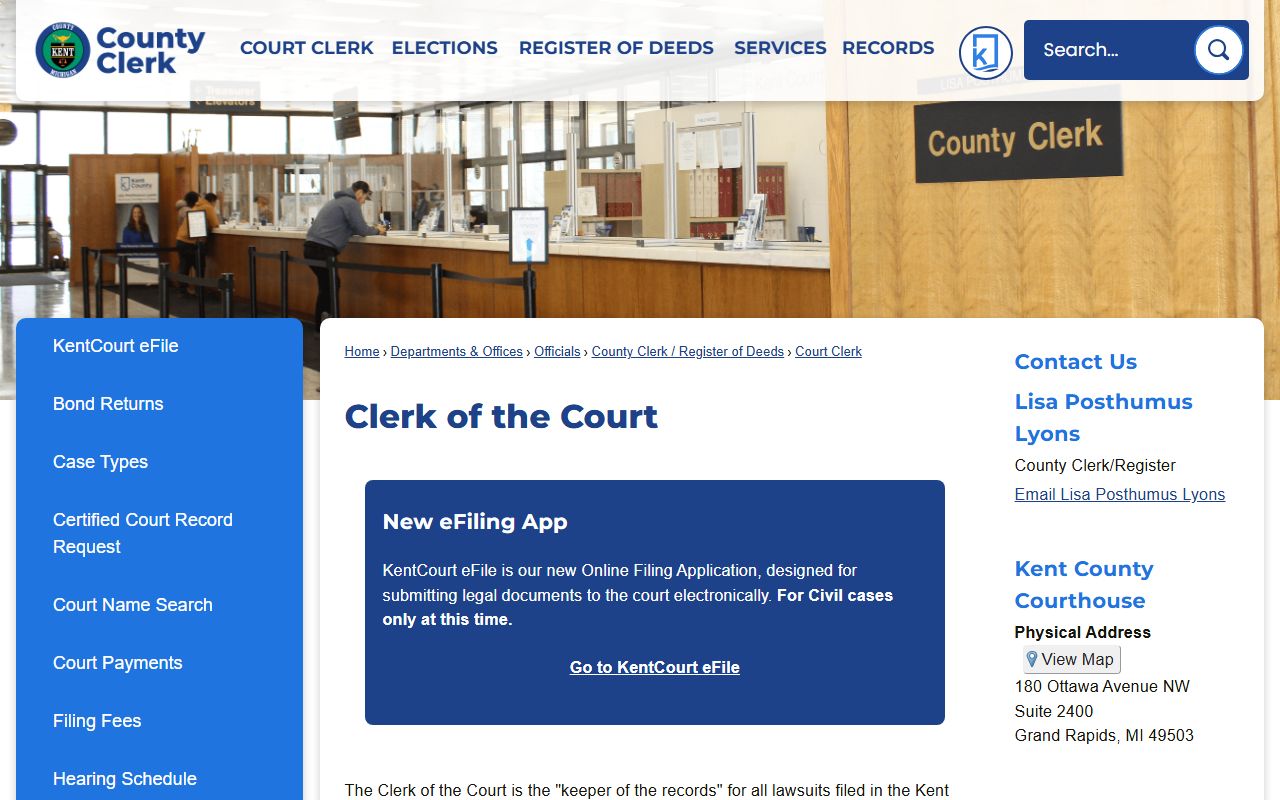
That page confirms the keeper-of-records language and the copy fees, which is why it anchors the office rather than a generic county contact screen.
17th Circuit Court Clerk
180 Ottawa Avenue NW, Suite 2400
Grand Rapids, MI 49503
616-632-5220 (court landing line)
616-632-5480 (case information)
Mon-Fri, 8:00 a.m. to 5:00 p.m.
Records the Circuit Court Clerk Keeps
The Circuit Court Clerk holds the files that flow through the 17th Circuit Court. That court handles higher-value civil suits, family cases such as divorce, and felony criminal matters. The clerk stores the pleadings, orders, and judgments in each of those files and lets the public view them at the office.
Most requests fall into a handful of record types. The list below covers what the office routinely pulls, copies, or certifies.
- Civil case files, including complaints, answers, motions, and money judgments
- Family division files, including judgments of divorce and support orders
- Felony criminal files, including charges, pleas, and sentencing orders
- Transcripts that have been filed with the court
- Certified copies of divorce judgments for legal use
- Current probate letters ordered through the certified-record portal
Older or non-digitized files are still best handled at the counter, since not every historical document sits in an online system. A phone call to the case information line first can save a trip when a file is hard to locate.
Kent County Clerk Copy and Certification Fees
The Circuit Court Clerk charges set fees for copies and certification, and the office publishes them plainly. Plain copies run one dollar a page. Transcripts already filed with the court are cheaper per page. Certification adds a flat fee on top of the copy cost, because a certified copy carries the clerk's seal that courts and agencies accept as genuine.
| Item | Amount |
|---|---|
| Copies, per page | $1.00 |
| Transcripts filed with the court, per page | $0.30 |
| Certification, added to a certified copy | $10.00 |
| Divorce judgment copy, uncertified | $7.00 |
| Divorce judgment copy, certified | $15.00 |
| Research fee if a record cannot be found | $6.00 |
The office accepts cash, checks, and money orders. Starter checks are not accepted, and some fees carry payment restrictions, so it helps to confirm the total before mailing a payment. Online orders through the county portal add a convenience fee to the base amounts above.
Note: A certified copy is required when a court or agency needs proof the document is genuine; an uncertified copy is fine for personal reference.
Ordering Certified Divorce Judgments and Probate Letters
Kent County runs an online certified-record order flow for two common documents. Certified copies of 17th Circuit Court divorce judgments sell for fifteen dollars each, and current probate letters sell for twelve dollars each. The system ships processed orders within five business days.
The Certified Court Record Request page explains what the portal can and cannot do before an order starts. It routes buyers into the ordering site for the document they need.
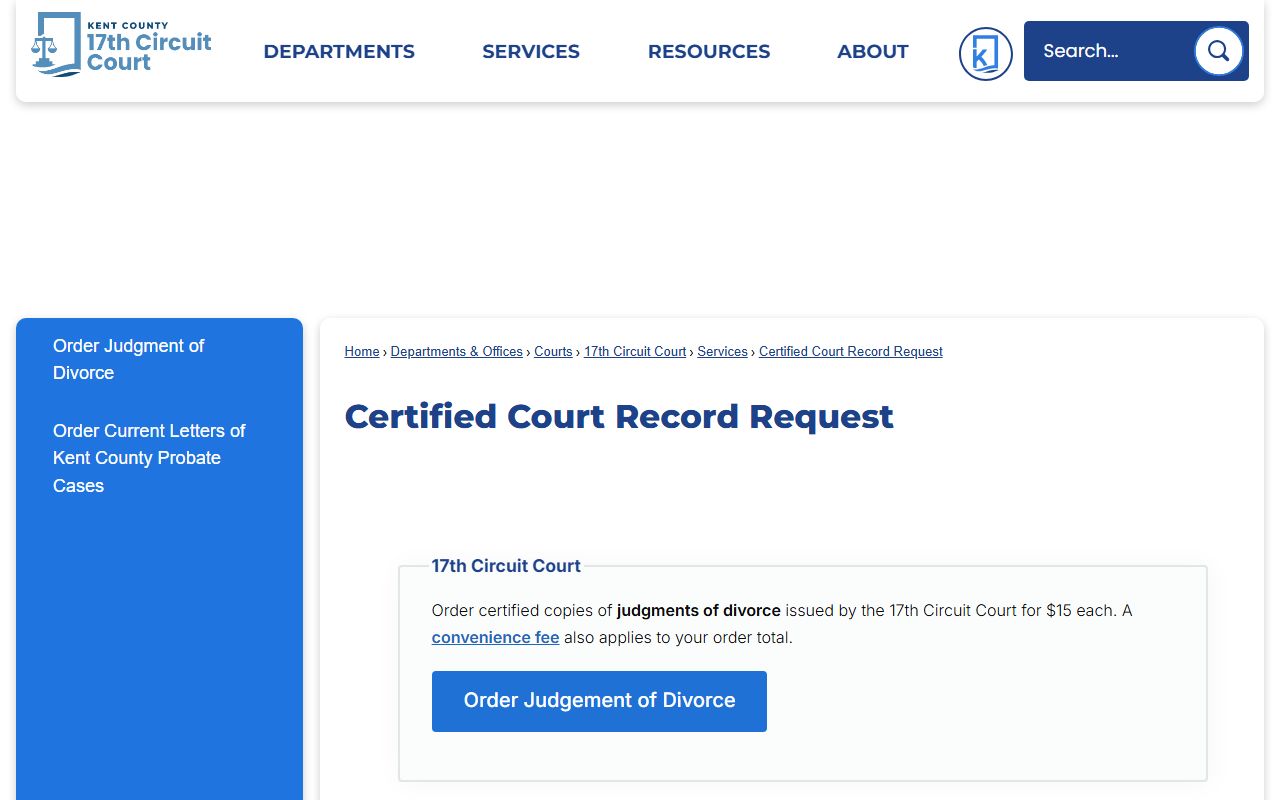
That request page connects to the county certified-record portal, where the actual order and payment happen.
The portal carries a few rules worth knowing. Probate and circuit records cannot be ordered in the same checkout session, so a buyer needing both must run two separate orders. If a record cannot be located because of a spelling issue or because the case is not in the system, the court charges a six-dollar research fee. International orders are not handled through the online portal and must go through the court directly. Marriage licenses and marriage certificates are a different track entirely; those move through the County Clerk and Register of Deeds rather than the Circuit Court Clerk.
How to Request a Certified Copy
A certified copy proves that a document matches the court's official file. People need one for name changes, remarriage, immigration, benefits, and other legal steps where a plain printout will not do. The path is short once the case details are in hand.
- Gather the case details, including party names and the case number if known, since the number is the fastest way to find a file.
- Choose the channel that fits the record. Divorce judgments and probate letters go through the online certified-record portal; other circuit files can be handled at the clerk counter or by contacting the case information line.
- Enter or provide the search details, then confirm the copy and certification fees before you submit.
- Pay by an accepted method. The portal takes card payment with a convenience fee, while the counter accepts cash, checks, and money orders.
- Collect the copy at the counter or wait for mail. Portal orders ship within five business days after processing.
Note: Entering the correct spelling and case year lowers the chance of the six-dollar research charge for a record the office cannot locate.
Kent County Records Request Form Fields
The online divorce order gives the clearest picture of what the certified-record request asks for. The search looks one year before and one year after the divorce year entered, so an approximate year still works. The table lists the core fields and whether each is required.
| Field | Required | Notes |
|---|---|---|
| Plaintiff Last Name | Yes | First-party name field. |
| Defendant Last Name | Yes | Second-party name field. |
| Plaintiff First Name | Yes | First-party given name. |
| Defendant First Name | Yes | Second-party given name. |
| Last Name Before Marriage | No | Only if different from current name. |
| Divorce Year | Yes | Dropdown; unknown, then 1925 through 2026. |
| Case Number | No | Optional but speeds the search when known. |
The probate order asks for slightly different details, including the ward's name, date of birth, and case type such as guardianship or conservatorship. Both forms end with a submit button that sends the search to the clerk's system for processing.
Name Search and Court Calendars in Kent County
Beyond copies, the clerk's side of the 17th Circuit Court supports online lookups and calendars. The county's Search Court Records page links to a 17th Circuit Court name search account login, hearing schedules, motion calendars, online payments, judges, and eFiling. These tools sit alongside the file room rather than replacing it.
The name search runs through a login wrapper, and recent entries may take time to post. For a full case file or an older document, the counter is still the reliable route. The 17th Circuit Court landing page gathers the same quick links for hearings, motions, and electronic filing.
Kent County spreads court access across several systems, so the search that works depends on the court and case type. Circuit files go through the circuit tools; district-court matters live in separate portals. A broader background check should go through the Michigan State Police rather than the court clerk, which keeps case files rather than criminal-history summaries. For a wider look at the county's lookup options, the Kent County court records overview maps the channels by court.
Applying for a Court-Appointed Attorney
People with a circuit case who cannot afford a lawyer have a defense-side path in Kent County. The county's public defender office provides holistic representation, pairing legal counsel with a social worker and, when the need is shown, investigators and experts. It works alongside the courts rather than through the clerk.
The public defender office keeps a staff directory so callers can reach the right person. The public defender staff directory lists the office contacts.
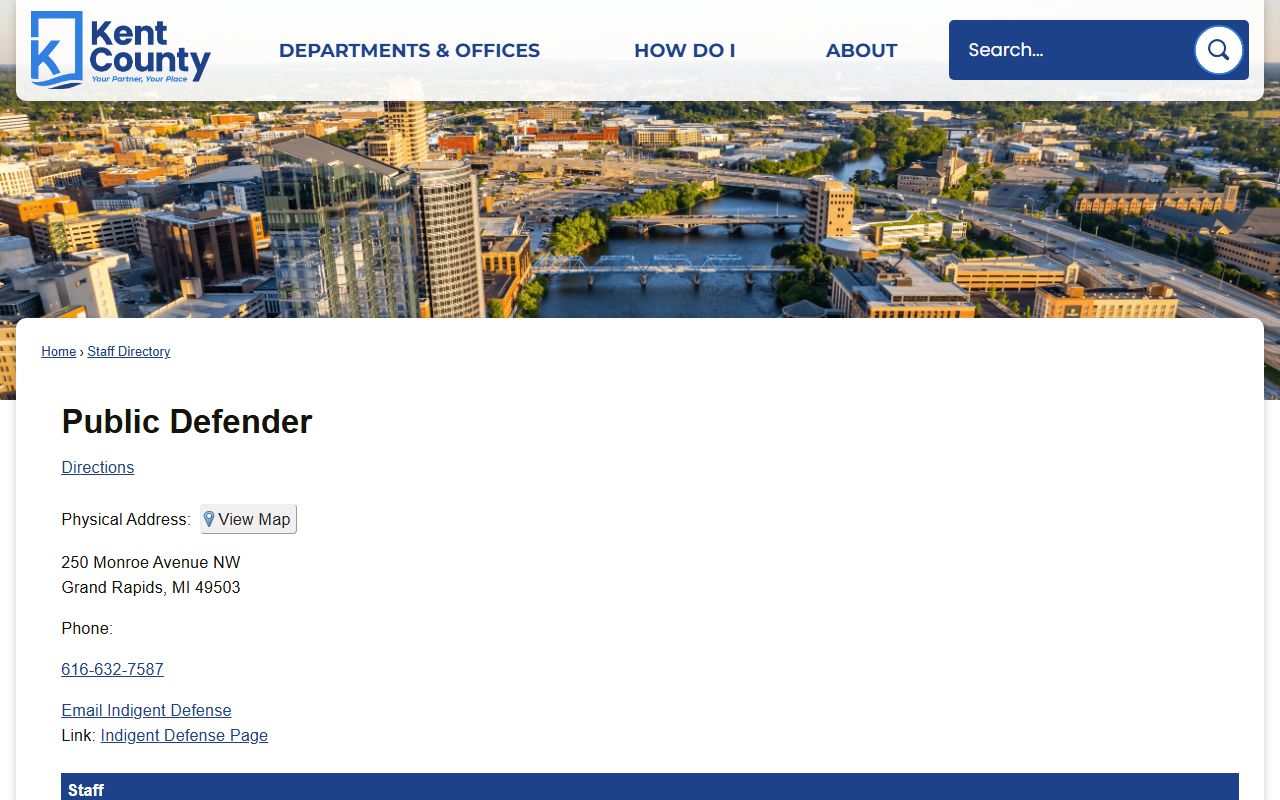
That directory backs up the county's online application, which gives a concrete first step toward appointed counsel.
Rather than a paper-only process, the county lets eligible people start online. The apply-for-an-attorney page opens the request for court-appointed counsel.
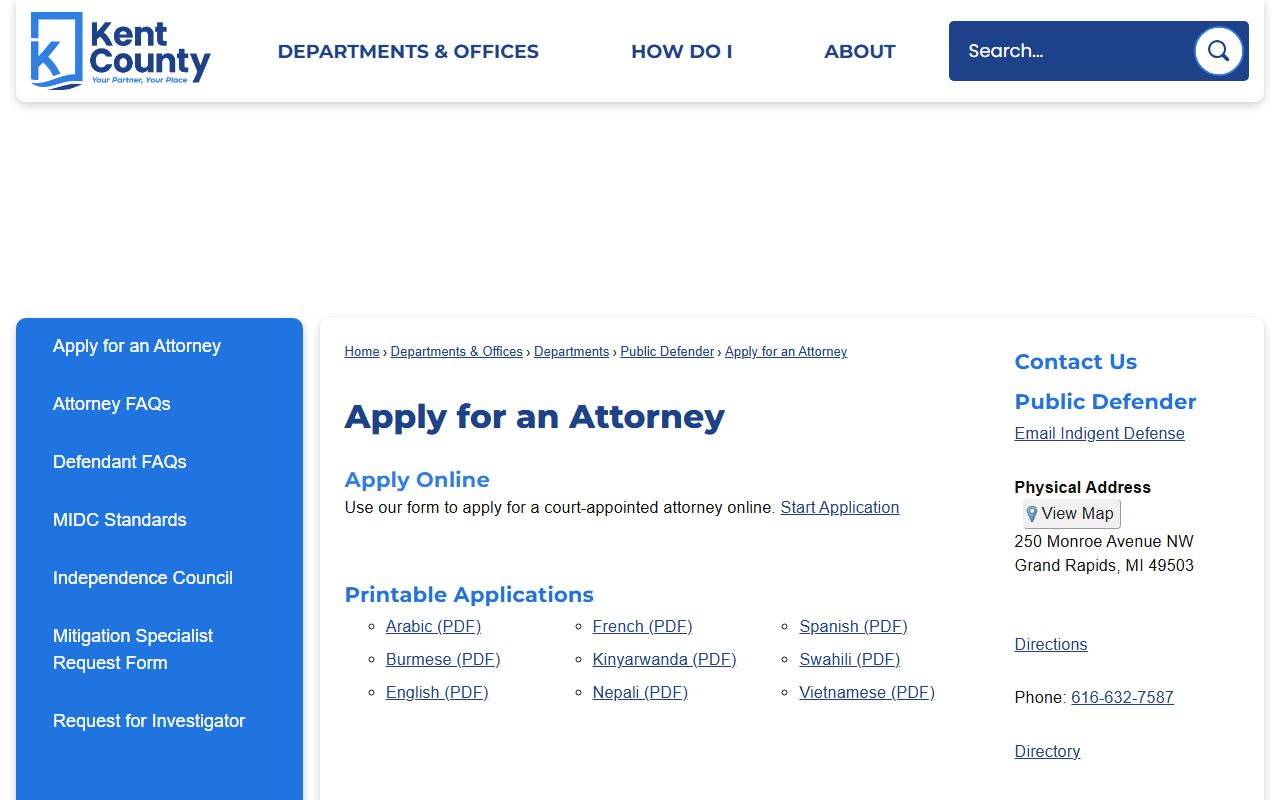
The application matters here because a circuit case often opens at the clerk's counter, and a defendant needs counsel lined up quickly once charges are filed.
Public Access and the Clerk's Limits
Court records in Michigan are public unless a rule or statute makes them nonpublic or sealed. That standard sits in MCR 8.119, which the Circuit Court Clerk follows when deciding what the public may inspect. Sealed files, juvenile matters, and set-aside convictions fall outside ordinary public access.
Requests for records held by county offices rather than the court can move under the Michigan Freedom of Information Act. A written request that describes the record well enough gives access unless an exemption applies, a rule set out in MCL 15.233. Court files, though, are governed first by the court rules, so a copy order at the clerk is usually the right route for a case document.
The clerk's job stops at the file. Staff can locate a document, quote the fee, and certify a copy, but they cannot interpret it or advise on strategy. For the difference between a docket summary and a full file, the Kent County court dockets page breaks down what each view shows.