
How to Search Kent County Court Records
There is no single universal database for every Kent County case. Instead, the county spreads searchable records across the 17th Circuit Court and the local district courts, and each system has its own tool. The circuit court search page links to a name-search account login, hearing schedules, online payments, judges, motion calendars, and eFiling. District courts run their own portals, from the 61st District Court public-access site in Grand Rapids to the Kentwood 62-B case grid and the state MiCOURT system used by the 62-A court in Wyoming.
Before starting, gather the case number if you have it, the full name of a party, and a date of birth for common names. Court staff across the county repeat the same advice: the case number is the fastest path, and a date of birth is the best way to narrow a common last name. The Kent County government homepage is a useful hub because it links every department, court office, and public service in one place.
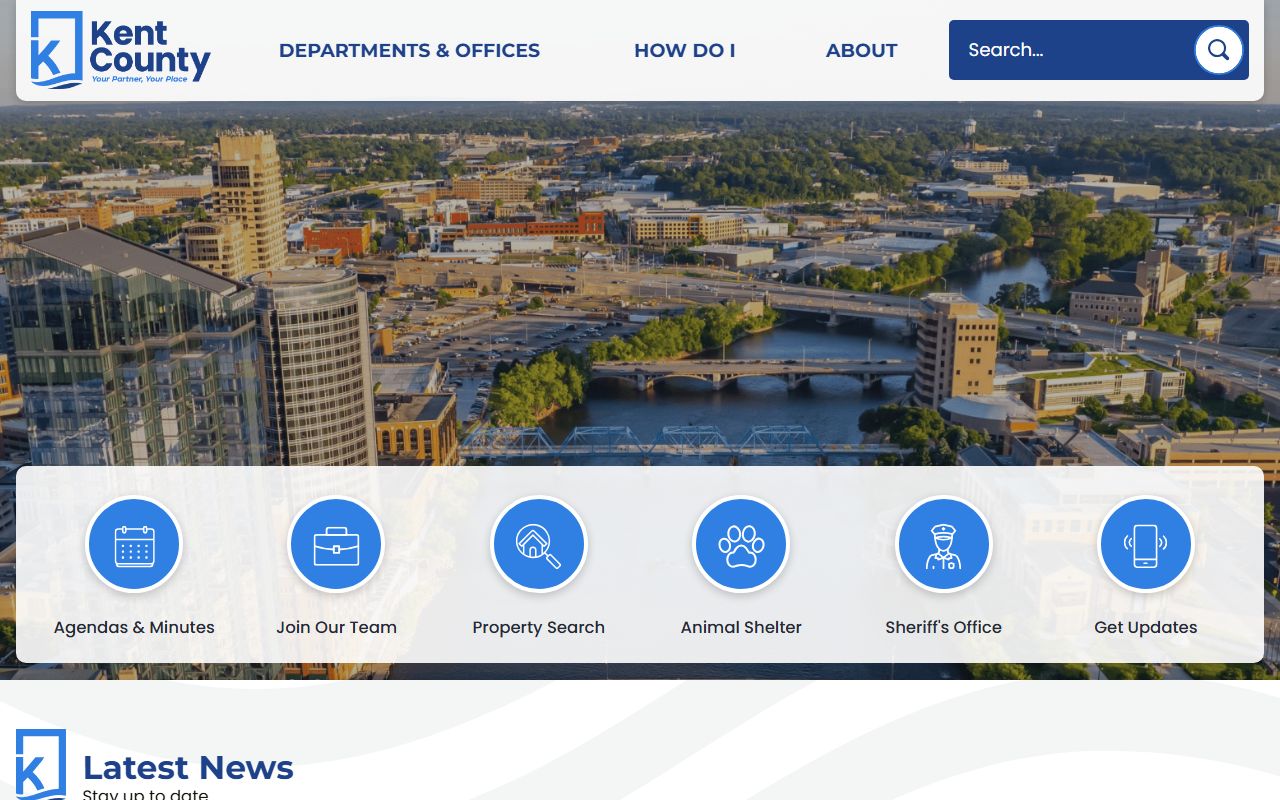
The homepage screen above shows how the county routes visitors from a single landing page to the courts, the clerk, and the sheriff. From there, a records search usually follows the same short sequence no matter which court owns the file.
- Open the county courts page and pick the court that handles your case type, then follow its search or case-lookup link.
- Enter a party name or a case number; use last name first, then add a date of birth if the name is common.
- Narrow the results by court, filing year, or case status such as open or closed.
- Open the register of actions to read the docket entries, hearing dates, and disposition.
- Order a certified copy through the clerk or the certified-record portal when you need a document for legal use.
The Kent County Judicial System
Michigan keeps its trial courts simple compared with many states. The three trial-court levels are the Circuit Court, the District Courts, and the Probate Court. Appeals rise to the Michigan Court of Appeals and then to the Michigan Supreme Court. Kent County fits that structure with a large 17th Circuit Court, five district-court venues, and a Probate Court inside the downtown courthouse complex.
The 17th Circuit Court is the county's higher trial court. It handles felony criminal cases, larger civil disputes, and family matters such as divorce and custody. The district courts move faster and smaller cases: misdemeanors, arraignments, bond, preliminary exams, small claims, landlord-tenant matters, and civil infractions. The county's district benches include the 59th in Walker and Grandville, the 61st in Grand Rapids, the 62-A in Wyoming, the 62-B in Kentwood, and the 63rd covering Cedar Springs, East Grand Rapids, Lowell, Rockford, and a long list of townships.
You can see how these offices connect on the Kent County courts landing page, which lists the main court offices and describes the wide reach of the 63rd District Court.
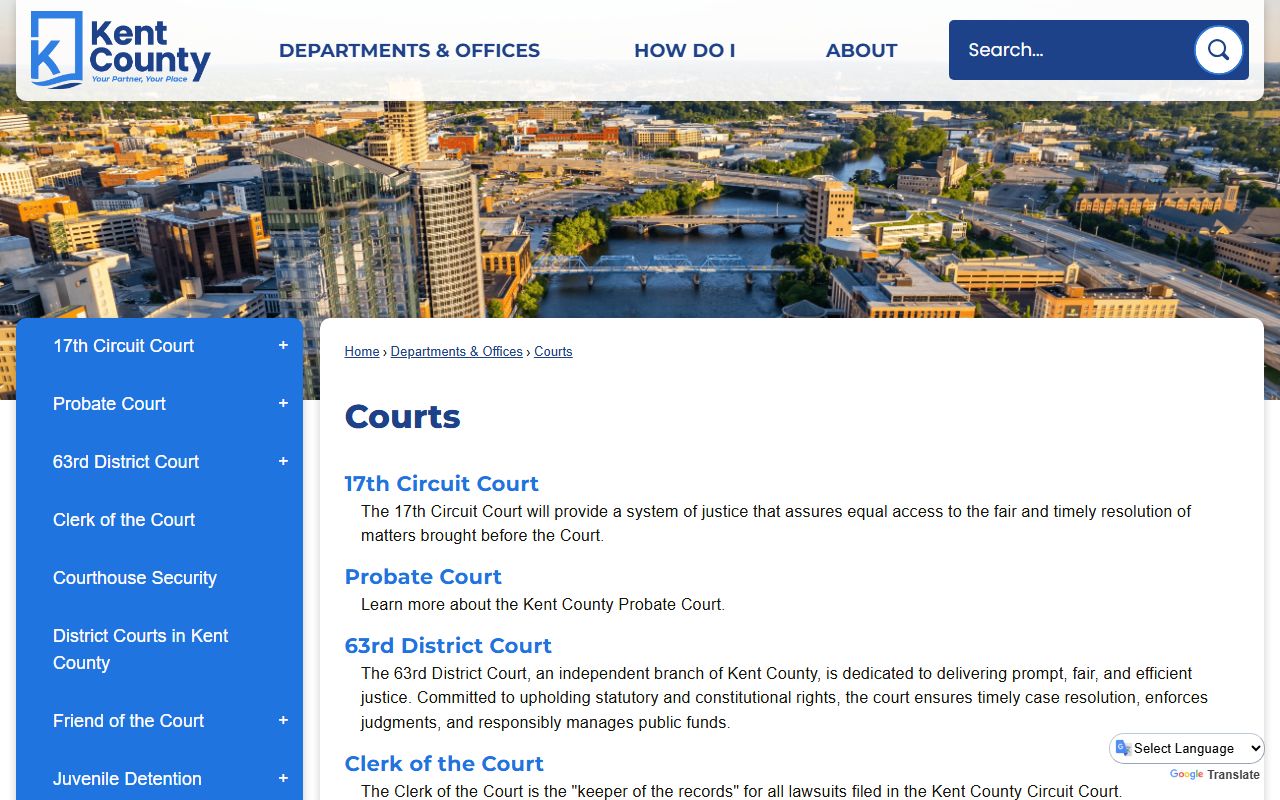
That courts page is the practical map for the whole system, showing which bench to approach first. The typical Michigan case flow is short and worth remembering.
Case flow: District Court › Circuit Court › Michigan Court of Appeals › Michigan Supreme Court
| Court | Jurisdiction | Case Types |
|---|---|---|
| 17th Circuit Court | Countywide, higher trial court | Felonies, larger civil suits, divorce, custody, family |
| District Courts (59th, 61st, 62-A, 62-B, 63rd) | Local municipal and township areas | Misdemeanors, arraignments, small claims, evictions, traffic |
| Probate Court | Countywide statutory matters | Wills, estates, guardianships, conservatorships, mental health |
| Michigan Court of Appeals | Statewide appellate | Appeals from the circuit and probate courts |
Kent County Courthouses
Kent County spreads its court functions across more than one downtown address, so the courthouse on Ottawa Avenue is not the only building that matters. The main hub is the Kent County Courthouse, home of the 17th Circuit Court, with the Circuit Court Clerk on the second floor in Suite 2400. The County Clerk and Register of Deeds sits a few blocks away on Monroe Avenue, the sheriff and jail operate on Ball Avenue, and the 63rd District Court works out of an East Beltline address on the northeast side.
The 17th Circuit Court is the anchor of that cluster. Its 17th Circuit Court landing page lists courthouse hours, contact numbers, and quick links to records, hearings, motions, judges, and eFiling.
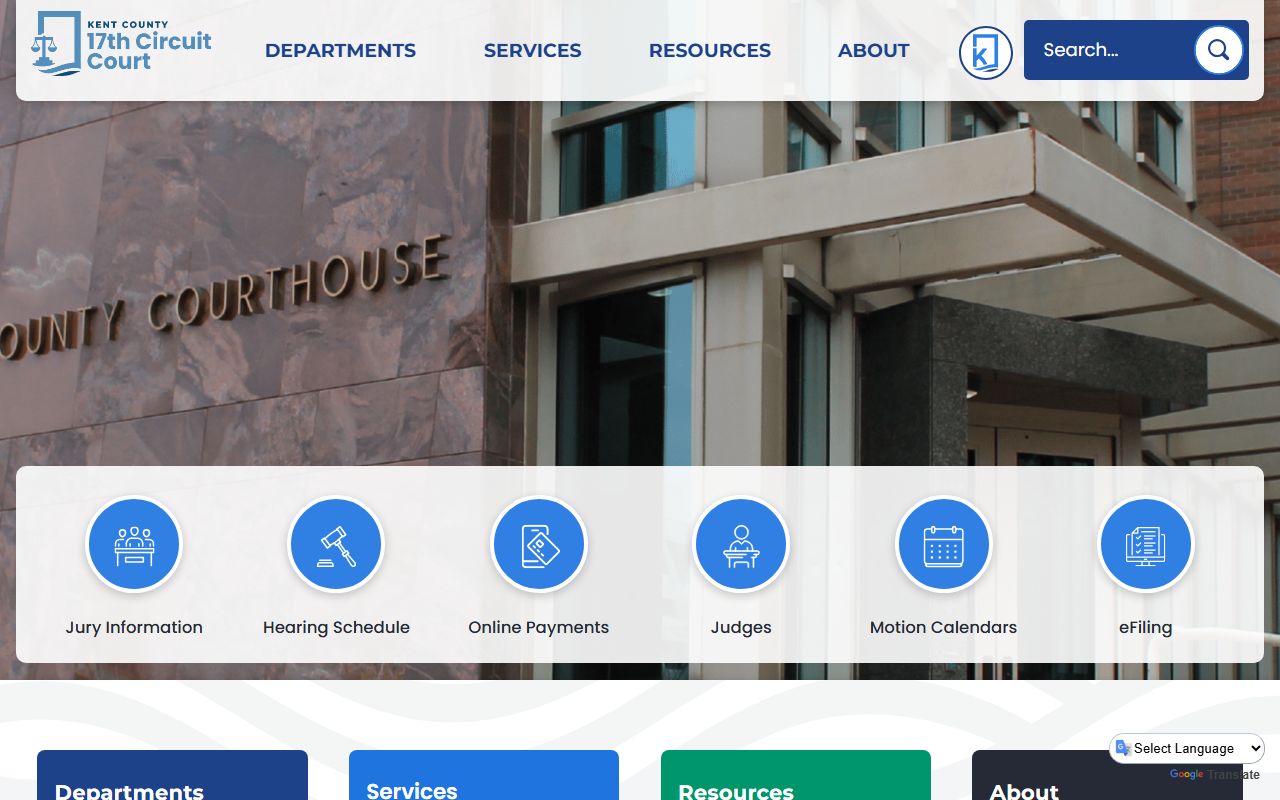
That circuit court page is the single best starting point for higher-level case work in the county. For anyone unsure where a specific bench sits, the county also publishes a map resource.
The maps to courts and parking page shows the location of each courthouse and the nearby lots and structures.
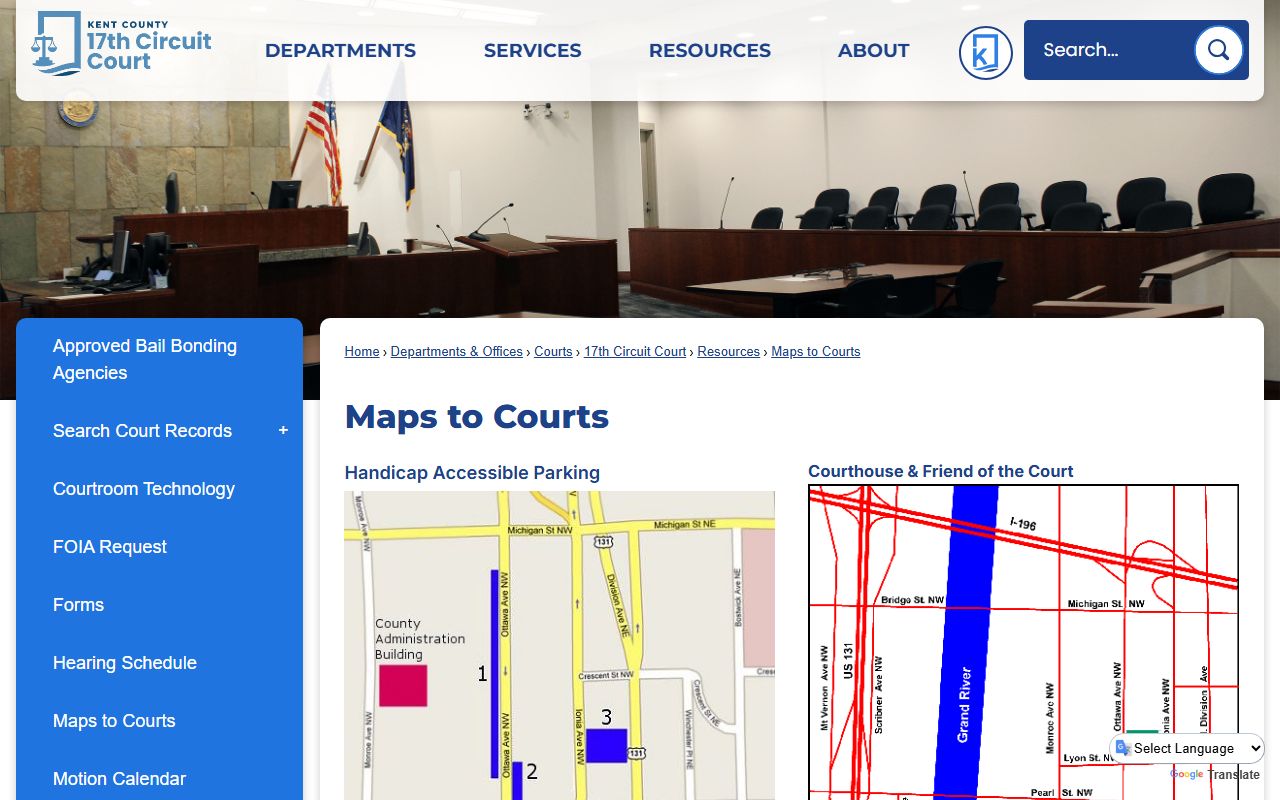
Those maps help first-time visitors avoid the wrong building, which is easy to do when four offices share a compact downtown footprint. Jurors and daytime visitors get an extra transit option worth knowing about.
The Kent County jury page explains that jurors can park free at the Gerald R. Ford lot and ride the Dash Shuttle to the courthouse.
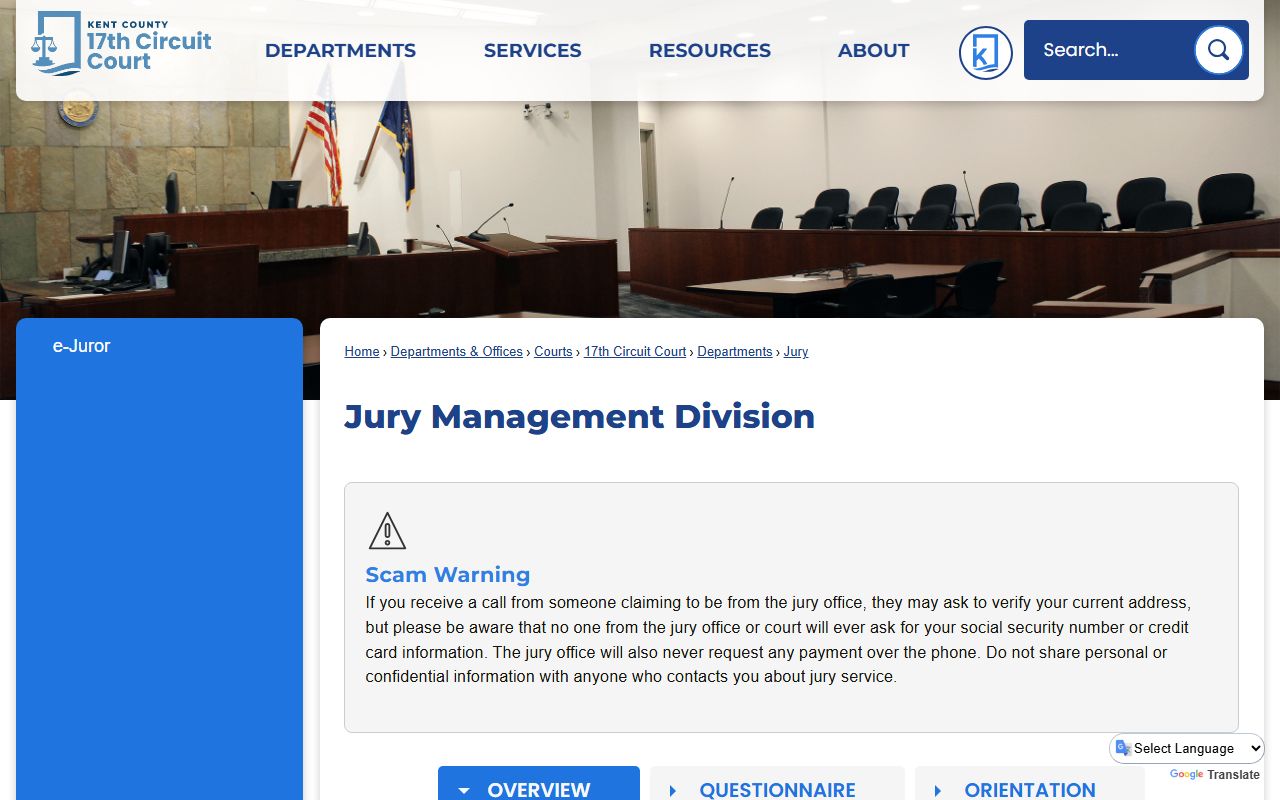
That free parking and shuttle detail is a small but real convenience, since downtown Grand Rapids parking is mostly meters and nearby lots. The addresses below cover the four buildings most records visitors need.
Kent County Courthouse (17th Circuit Court)
180 Ottawa Avenue NW, Suite 2400
Grand Rapids, MI 49503
616-632-5220
County Clerk / Register of Deeds
300 Monroe Avenue NW, Floor 1
Grand Rapids, MI 49503
616-632-7640
Kent County Correctional Facility
703 Ball Avenue
Grand Rapids, MI 49503
616-632-6300
Note: The 61st District Court also sits at 180 Ottawa Avenue NW, so the downtown courthouse holds both circuit-level and district-level cases under one roof.
Types of Court Records Available in Kent County
Kent County produces the full range of Michigan court records, and the type of case usually tells you which court holds the file. Felony criminal and higher-value civil matters route through the 17th Circuit Court, while misdemeanors, small claims, and evictions live in the district courts. Family and probate matters follow their own tracks, and some record types stay confidential by law.
Divorce judgments are ordered through the circuit-record portal, current probate letters can be ordered online, and marriage licenses run through the County Clerk. That split is why one search rarely returns every document tied to a single family or person.
- Criminal records - felony files in Circuit Court and misdemeanor files in the district courts, with pleas, sentencing, and probation terms.
- Civil records - complaints, answers, motions, judgments, and appeals, most of the larger cases handled by the Circuit Court.
- Family and divorce records - divorce files, custody orders, support matters, and personal-protection proceedings.
- Probate records - wills, estates, guardianships, conservatorships, and letters of authority.
- Traffic records - civil infractions and ticket-related cases, which are separate from the state driving record.
What Kent County Court Records Show
Public court records in Kent County tend to follow standard Michigan fields, though the exact mix depends on the court system. The 62-B public case grid, for example, shows columns for case number, status, name, date of birth, and attorney, and each row can be expanded for case detail. The jail viewer adds an arrest-side layer with a booking number, booking date, demographics, and charges filed by the arresting agency.
Common fields across the county's court systems include the case number, the parties, the filing date, the case status, hearing dates, the assigned judge, the attorney of record, the case type, and the disposition. Case status values such as open and closed appear on district portals, and criminal search screens accept a last name plus ticket number or date of birth. Michigan rules also require public filings to omit protected personal information, so Social Security numbers and some data are redacted rather than displayed.
| Field | What It Shows |
|---|---|
| Case Number | The court's unique identifier, often combining the filing year and a court-specific code. |
| Filing Date | The date the case opened with the clerk. |
| Parties | The plaintiff, defendant, petitioner, or respondent named in the case. |
| Charges / Cause | The criminal charge or the civil cause of action driving the case. |
| Disposition | The outcome, such as a plea, verdict, dismissal, or judgment. |
| Sentence / Judgment | The penalty imposed or the money and orders awarded. |
Public Access Laws for Kent County Court Records
Michigan treats court records as open by default. The practical rule is straightforward: a public case record stays open unless a statute, a court rule, or a judge's order makes it nonpublic. Court records themselves are governed first by the Michigan Court Rules, while the Freedom of Information Act covers sheriff and county-office records outside the courtroom file.
In Kent County the starting point is always the office that keeps the file. Circuit Court records go through the circuit clerk, probate letters through the probate and circuit record portal, marriage licenses through the County Clerk, and jail information through the sheriff or the jail viewer. Sealed, juvenile, and expunged records are the main exceptions where the public view is limited or gone.
Key Statutes:
Michigan Code § MCL 15.233 - A written FOIA request that describes the record clearly gives access to public records unless an exemption applies.
Michigan Court Rule § MCR 8.119 - Court records are public unless a rule or statute makes them nonpublic or sealed.
Michigan Court Rule § MCR 1.109 - Public filings must omit protected personal identifying information.
Michigan Code § MCL 780.621 - The main conviction-setting-aside statute for expungement requests.
Michigan Code § MCL 712A.18e - Juvenile offenses carry special confidentiality and set-aside rules.
Michigan Code § MCL 28.243 - Criminal-history records run through the state police records system, which defines what gets disseminated.
Records That Are Restricted or Confidential
Not every Kent County record sits in open public view. Michigan requires public filings to omit protected personal identifying information, so some data is redacted rather than sealed. Beyond that, whole categories of cases are treated as nonpublic because of the people or subjects involved.
Common restricted categories include juvenile records, which are usually limited and handled separately from ordinary adult files; sealed records, which need a court order for access; expunged records, which become nonpublic once a conviction is set aside; adoption records; and mental-health proceedings filed through the Probate Court under statutory confidentiality. Dates of birth, Social Security numbers, and account numbers are frequently redacted from public filings.
Expungement in Michigan follows a clear path. The person files the statutory application, pays any filing fee that is not waived, waits out the required period after conviction or sentence completion, and then asks the court to set the conviction aside. If a judge approves, the conviction stops appearing in ordinary public access, though it may remain in limited law-enforcement systems.
Specialty Courts in Kent County
Kent County runs a real problem-solving court ecosystem, not just a single drug-court label. These treatment-focused benches change how some cases move and why certain records are handled differently from a standard criminal docket. They also reflect a deliberate shift toward treatment over a purely adversarial track.
The Treatment and Support Court, known as TASC, is the adult problem-solving court for people with co-occurring substance-use and mental-health issues who have entered the criminal system. The Juvenile Treatment and Support Court, JTASC, does the same work for youth, aiming for stability, better school performance, and less future justice involvement. Both use a team of a coordinator, prosecutors, defense counsel, probation, and clinical liaisons.
Several other specialty benches round out the system. Sobriety Court serves eligible repeat drunk-driving offenders with assessment, drug testing, and individualized treatment. A Mental Health Treatment Court operates within the 17th Circuit Court, a Recovery Court for addiction cases started in 2019, and a Veterans Treatment Court receives ongoing county support and funding.
Kent County Sheriff and Jail
The Kent County Sheriff's Office, led by Sheriff Michelle LaJoye-Young, is the main entry point for jail records, inmate lookups, and public-records requests. The Kent County Correctional Facility on Ball Avenue is a secure complex built to house up to about 1,500 inmates across security levels. The public jail viewer covers people currently held there and can show descriptive information, mugshots, and the offenses charged by the arresting agency.
The Kent County Sheriff landing page is the hub for that side of the system, with links to records, corrections, and public-safety news.
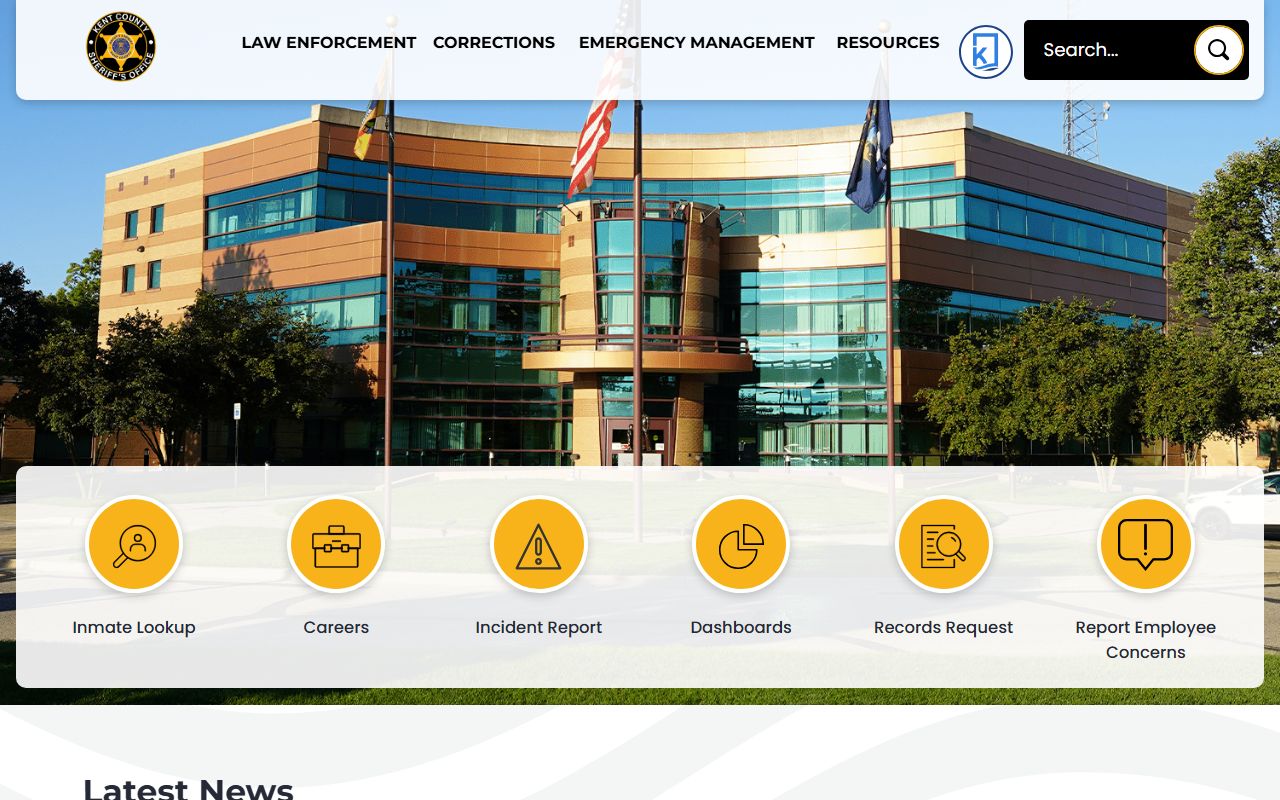
The sheriff page connects the jail viewer, the records unit, and the inmate information line in one place. The booking search itself is public and simple to use, requiring a full last name to begin.
| Field Label | Type | Required | Notes |
|---|---|---|---|
| Last Name | text | Yes | Must be a complete last name; the search starts here. |
| First Name | text | No | Optional field for narrowing results. |
| Booking From Date | date | No | Optional; only works together with a name. |
| Booking To Date | date | No | Optional; only works together with a name. |
| Search | button | Yes | Submits the booking query. |
| Clear | button | Yes | Resets the form. |
If the online viewer does not answer a question, the jail runs an inmate information line at 616-632-6300, option 1, and the records unit and FOIA desk answer at 616-632-6200. The sheriff also offers a public reporting and tip app, but it does not include an inmate or warrant search. For the full booking roster and profile detail, see the Kent County inmate records page, and check active-warrant options on the warrant records page.
Marriage, Divorce, and Probate Records
Family and estate records in Kent County are split across two offices. Marriage licenses and certified marriage copies come from the County Clerk, while divorce judgments are ordered through the 17th Circuit Court certified-record portal. Probate matters, from wills to guardianships, run through the Probate Court in the same downtown courthouse complex.
Marriage records are public, and anyone may buy a copy. Divorce judgments and current probate letters can be ordered online, though the portal will not let you order probate and circuit records in the same checkout. For step-by-step fees and forms, the marriage and divorce records page and the probate records page break down each path in detail.
- Testator
- A person who makes a valid will directing how their property passes at death.
- Executor
- The person named to carry out the terms of a will and settle the estate.
- Conservator
- A person appointed by the Probate Court to manage another adult's finances or property.
- Intestate
- Dying without a valid will, so state law decides who inherits.
- Guardianship
- Court-appointed authority to make care or decision-making choices for another person.
Kent County Court Records Fees
The Circuit Court Clerk publishes clear copy fees, and the county's certified-record portal lists set prices for divorce and probate orders. The clerk accepts cash, checks, and money orders, but not starter checks, and some fees carry payment restrictions. The Kent County court phone directory is handy when you need to confirm a fee or reach a specific office before you pay.
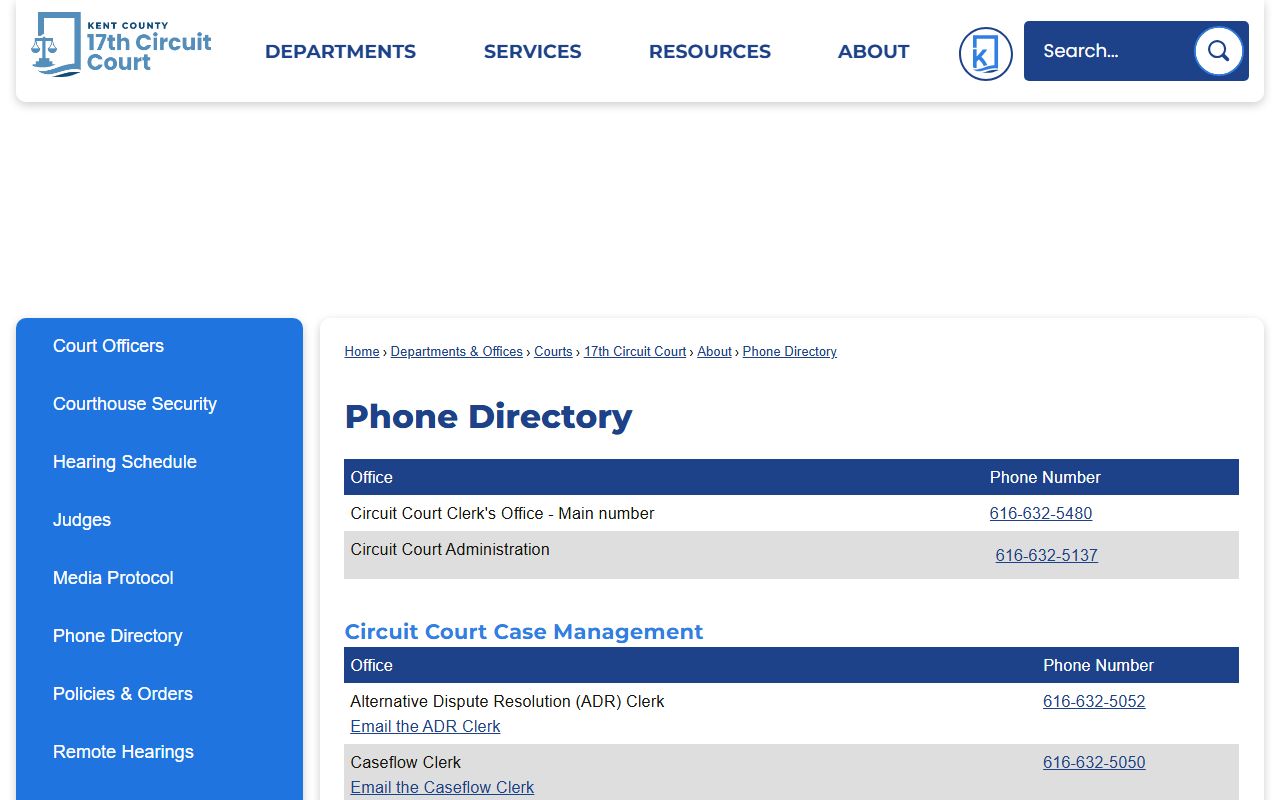
That directory lists the numbers for each court office, which saves a trip when a fee or filing question comes up. The core copy and certification fees are summarized below.
| Item | Amount |
|---|---|
| Plain copy per page | $1.00 |
| Transcript copy per page | $0.30 |
| Certification fee | $10.00 |
| Records research fee (record not found) | $6.00 |
| Certified divorce judgment | $15.00 |
| Current probate letters | $12.00 |
Orders placed through the certified-record portal are processed and shipped within five business days, and online orders add a convenience fee. International orders must go through the court directly rather than the portal.
How to Interpret Kent County Court Records
Reading a Kent County record gets easier once you know which court produced it and what its status codes mean. A charge is only an accusation, while a conviction is a finding of guilt, so an open case with pending charges is not the same as a decided one. District portals use plain status values such as open and closed, and the register of actions lists every event in the order it happened.
The three trial courts hold different files, and the table below shows what each one typically keeps and where a search should begin.
| Feature | Circuit Court | District Court | Probate Court |
|---|---|---|---|
| Main cases | Felonies, big civil suits, family | Misdemeanors, small claims, traffic | Estates, guardianships, mental health |
| Typical record | Case file and judgment of divorce | Ticket, arraignment, small-claims file | Wills, letters of authority |
| Where to search | Circuit clerk and name-search login | District portals and MiCOURT | Probate name search and letters portal |
A case number often combines the filing year and a court-specific code, which is why the same person can carry different numbers in the circuit and district systems. When a screen shows a disposition, read it with the sentence or judgment line, since the outcome and the penalty are recorded separately.
Accuracy and Record Limitations
Online court and jail data move at different speeds, and none of it is guaranteed to be complete. Court portals warn that recent entries may not appear right away, and the sheriff does not promise that roster data is current, accurate, or complete. Jail information in particular changes quickly and should not be used for legal action.
Some files never appear online at all. Older or non-digitized cases, sealed matters, and nonpublic filings are still best handled at the clerk counter, by phone, or through a formal records request. When a record affects a legal right, a hearing, or a background decision, confirm it with the office that keeps the original file.
Note: Always verify a case detail with the originating court or clerk before relying on an online record for a legal, employment, or housing decision.
History of Kent County Courts
Kent County has grown into a major West Michigan jurisdiction, and its court system reflects that scale. The county covers 872 square miles and includes 21 townships, five villages, and nine cities, ranking as the fourth most populous county in Michigan and one of the fastest growing. That size is exactly why the county maintains multiple district courts around a central circuit-court hub in Grand Rapids.
The county's About page lays out that population and geography, which helps explain the county's spread of court venues.
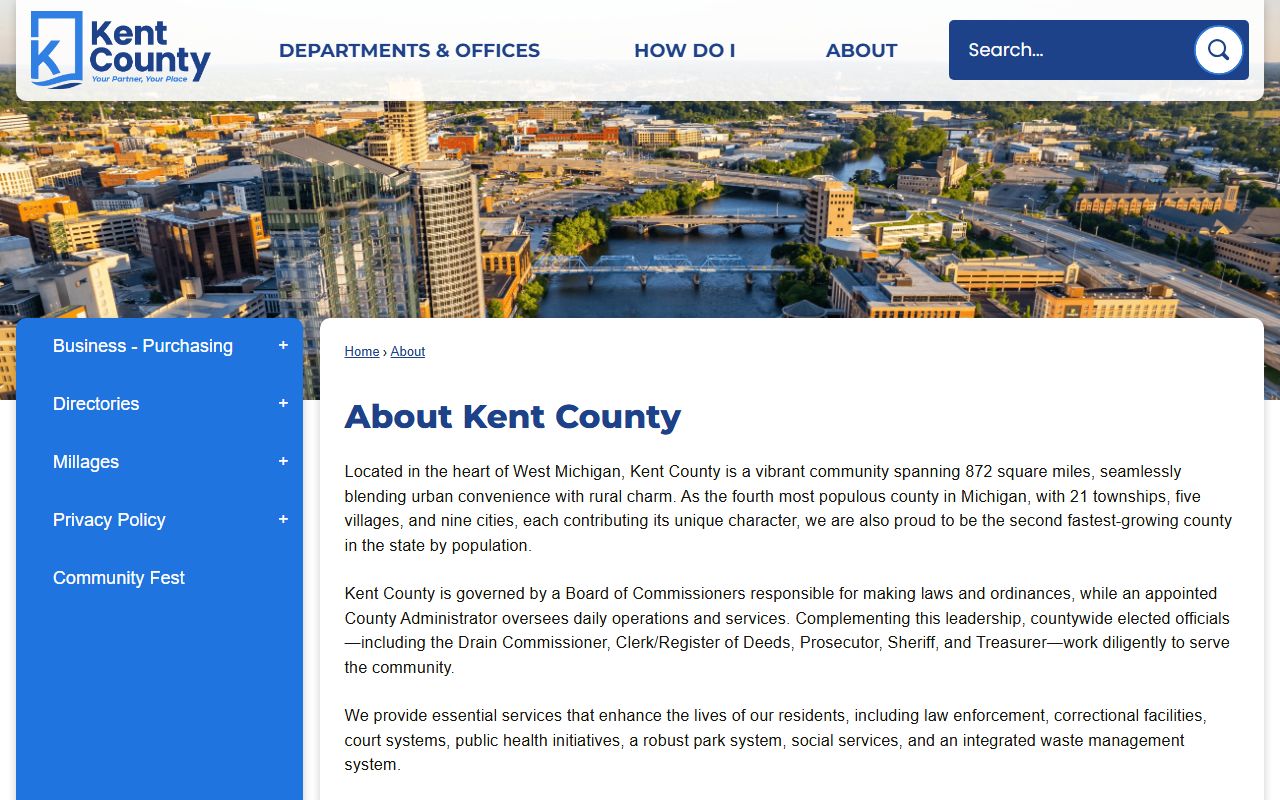
The size and population overview shows why one downtown courthouse could never handle every case in the county. The deeper backstory sits on a separate county page.
The Kent County history page gives local background on how the county developed around Grand Rapids since it was organized in the early 1830s.
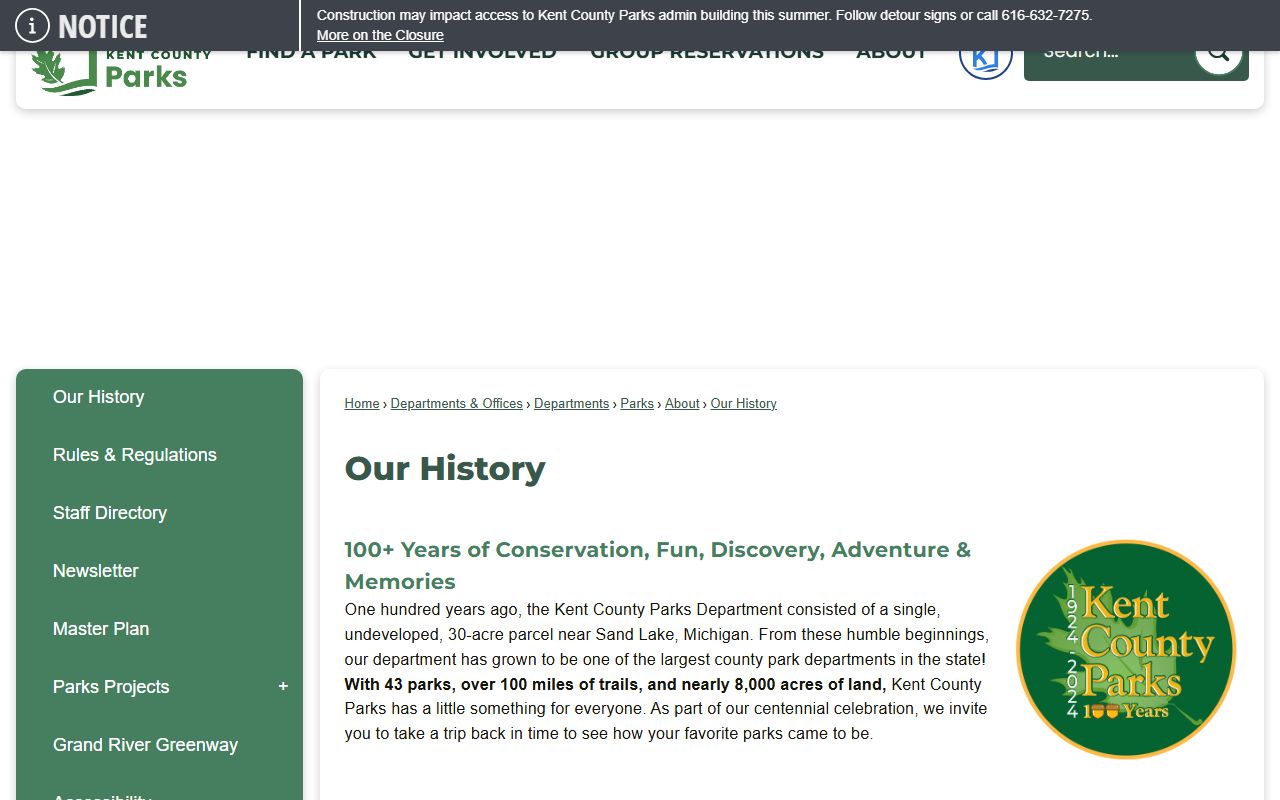
The history page frames the growth that shaped today's court structure. The real modern story, though, is digitization: eFiling at the circuit court, a jail viewer in place of a paper roster, case-search portals at several district courts, and an imaged vital-record system at the County Clerk. Milestones include the 2019 start of Recovery Court and the 2020 move of minor guardianship cases from probate to circuit court.
Court news keeps moving too, from the 2024 launch of the county public defender office to ongoing pushes for online hearing schedules and eFiling. The Kent County news feed tracks those updates as they happen.
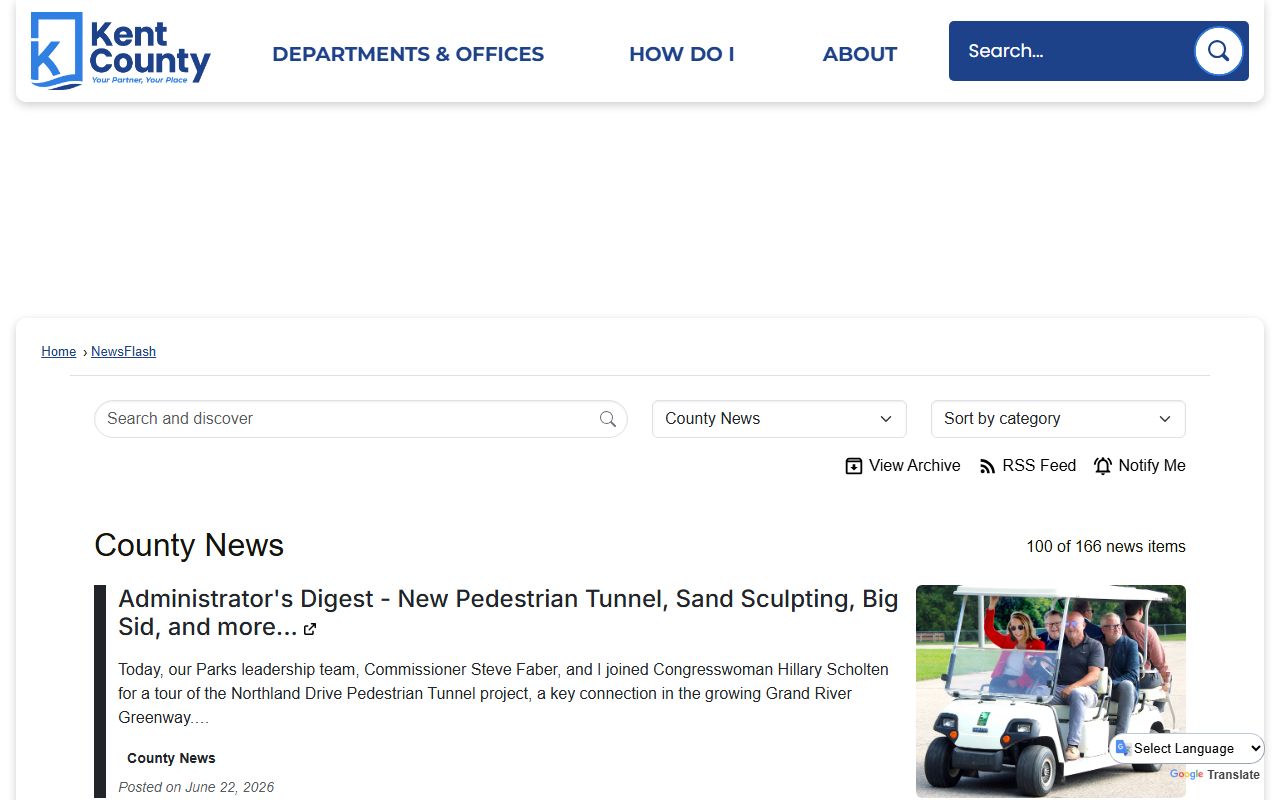
That news feed is the best way to catch current changes, since court access rules and jail procedures have shifted several times in recent years.
Frequently Asked Questions
How do I search Kent County court records online?
Start with the court that handles your case type. Felony and large civil cases are in the 17th Circuit Court, while misdemeanors, small claims, and traffic sit in the district courts. Each court has its own portal, from the 61st District Court public-access site to the Kentwood 62-B case grid and the MiCOURT system used by the 62-A court. Use the case number if you have it, then the party name and a date of birth for common names.
Are Kent County court records public?
Yes, most are. Michigan treats court records as open unless a statute, a court rule, or a judge's order makes them nonpublic. Sealed cases, juvenile matters, expunged convictions, adoptions, and mental-health proceedings are the main exceptions. Public filings also have protected personal information redacted, so items like Social Security numbers do not appear on the public screen even in an open case.
How do I get a certified copy of a divorce or probate record?
Certified divorce judgments and current probate letters are ordered through the county's certified-record portal or at the Circuit Court Clerk counter. A certified divorce judgment costs $15 and current probate letters cost $12, with online orders adding a convenience fee. If the office cannot locate a record from the name or data you supply, a $6 research fee applies, and orders ship within five business days.
How do I find out if someone is in the Kent County Jail?
Use the public jail viewer, which covers people currently held at the Kent County Correctional Facility. Enter a complete last name to begin, and add a first name or booking date range to narrow the list. If the online tool does not answer your question, call the inmate information line at 616-632-6300, option 1. Jail data changes quickly and is not guaranteed to be complete.
Does Kent County publish an online warrant list?
The county does not post a simple countywide active-warrant list. Instead it offers a fallback chain: the sheriff records unit at 616-632-6200, Friend of the Court bench-warrant help at 616-632-5733, the court that issued the warrant, and the jail information line if the person is already in custody. Deputies also transport people with active county warrants who are held outside Kent County.
Where do I get a Kent County marriage license?
Marriage licenses are issued by the County Clerk and Register of Deeds at 300 Monroe Avenue NW. The fee is $20 when at least one applicant lives in Kent County and the wedding is in Michigan, or $30 when both applicants live out of state and the ceremony is in the county. You must already have a wedding date and an authorized officiant, and the ceremony must happen within 33 days of applying.
What is the difference between a court traffic record and a driving record?
They are two separate files. The court traffic record shows the citation as a case, including the charge, court date, disposition, and fine, and it lives with the district court that handled the ticket. The Michigan Secretary of State driving record shows licensing status, conviction history, points, and suspensions. Points stay on the state driving record for two years after a conviction.