
Criminal Court Records in Kent County
A criminal court record is the case file the court clerk opens the moment a prosecutor files charges. It is not a single sheet. It is a running history of everything that happens in the case, from the first appearance to the last order. The clerk who keeps that file is the "keeper of the records," and the file stays with the court that has the case. Felony files sit with the 17th Circuit Court and its clerk. Misdemeanor files sit with the district court that handled the citation or complaint. Each entry is added as the case moves, so a criminal court record grows over time rather than being written all at once.
Two court levels produce these records in Kent County. Felony matters, higher civil cases, and family cases run through the 17th Circuit Court in the downtown courthouse. Faster and smaller criminal matters run through the district courts. The county has five district venues: the 59th District Court in Walker and Grandville, the 61st District Court in Grand Rapids, the 62-A District Court in Wyoming, the 62-B District Court in Kentwood, and the 63rd District Court, which covers Cedar Springs, East Grand Rapids, Lowell, Rockford, Casnovia Village, and a long list of townships. District courts handle arraignments, bail, preliminary exams, and misdemeanor pleas, while felonies bind over to Circuit Court for trial and sentencing.
The charges themselves are examined in more depth in the Kent County arrest records and court charges pages, while the broader file room is covered under Kent County court records. The criminal case file ties all of it together into one docket.
How to Search Kent County Criminal Court Records
There is no single countywide criminal database. Kent County uses a mix of court-native tools instead. The 17th Circuit Court offers a Name Search Account Login for its cases, the 61st District Court runs a public-access login portal, and the 62-A, 62-B, and 63rd District Courts route searchers to MiCOURT and their own case grids. A search usually starts with the court that owns the case.
- Identify the court level. Felony cases point to the 17th Circuit Court; misdemeanor and traffic-linked cases point to the district court for that city or township.
- Open that court's case-search portal, such as the 17th Circuit Name Search login or the MiCOURT register of actions used by the 62-A and 63rd courts.
- Search by case number when you have it, because every court in the county calls the case number the fastest path to a record.
- If you only have a name, add a date of birth, since the courts recommend a DOB to narrow common names and suggest the "contains" filter.
- Open the case to read the register of actions, the disposition, and the sentence, then request a certified copy from the clerk if you need one for legal use.
For records that cross county lines or predate a portal, a statewide criminal-history check runs through the Michigan State Police under MCL 28.243, which governs how criminal-history data is disseminated. The 62-B District Court makes the same point, telling searchers that a broad background check without a case number should go through the State Police or Department of State systems rather than the local case grid.
Stages of a Kent County Criminal Case
A criminal court record reads more clearly once you know the stages a case passes through. Each stage adds its own entries to the file, so the docket is really a timeline of these steps. The path below shows the typical order from the day charges are filed to the day a sentence is imposed.
Charges Filed › Arraignment › Pretrial / Motions › Plea or Trial › Disposition › Sentencing
At arraignment, the first hearing, the court reads the charges and the defendant enters a plea of guilty, not guilty, no contest, or stands mute. Bond and release conditions are set here, and the entry appears near the top of the register of actions. During the pretrial and motions stage, both sides exchange information, argue motions, and often negotiate. Felony cases may include a preliminary exam in district court before the case binds over to the 17th Circuit Court. Every motion, order, and hearing date lands in the file as it happens.
The plea or trial stage decides guilt. Most cases resolve by plea, but a contested case goes to a bench or jury trial. Disposition records the outcome, and sentencing records the punishment. The Kent County Prosecutor's Office appears for the state at these stages, and a defendant who cannot afford a lawyer may be represented by the county public defender or appointed counsel.
What a Kent County Criminal Court Record Shows
The exact fields depend on the court system, but Kent County criminal files carry a standard set of Michigan data points. The 62-B public grid, for example, shows case number, status, name, date of birth, and attorney, and each row expands into fuller case detail. Michigan court rules require public filings to omit protected personal identifying information, so items like Social Security numbers stay out of the ordinary public view.
| Field | What It Shows |
|---|---|
| Case Number | The court's unique file identifier, usually combining the filing year and a court-specific code. |
| Defendant | The person charged, listed with name and often a date of birth to separate common names. |
| Charges | Each offense as filed, with its statute reference and severity level, plus any later amendments. |
| Plea | The response entered to the charges: guilty, not guilty, no contest, or standing mute. |
| Register of Actions | The dated docket history of every motion, hearing, and order in the case. |
| Disposition | The outcome of each charge, such as convicted, dismissed, or acquitted. |
| Sentence | The punishment imposed after conviction, including jail, probation, fines, or program terms. |
Case status values are simple on the public side. The 62-B portal uses labels like OPEN and CLOSED, and the register of actions is where the real story sits. Reading the file from the top down follows the case in the order it actually happened.
Reading Dispositions and Sentences
The disposition line is the outcome of the case, and the sentence line is what follows a conviction. A record can show several dispositions when a case carries more than one charge, since each count is resolved on its own. A few terms come up again and again in Kent County criminal files.
- Guilty: the defendant admitted the charge or was found guilty at trial.
- Not guilty: a plea of denial, or an acquittal after trial.
- No contest (nolo): the defendant does not fight the charge but does not admit it, and the court may treat it like a conviction for sentencing.
- Standing mute: the defendant says nothing, and the court enters a not-guilty plea on their behalf.
- Dismissed: the charge was dropped, either with prejudice, meaning it cannot be refiled, or without prejudice, meaning it can.
- Deferred: judgment is held back while the defendant completes conditions, which can lead to a reduced record if terms are met.
The sentence entry spells out the punishment. It may include jail time, probation with supervision, fines and costs, restitution, or placement in a treatment program. On a probation sentence, the file also lists the length and the conditions the court set.
Charges vs. Convictions
Being charged is not the same as being convicted. A criminal court record can show charges that were later dropped, dismissed, reduced, or that ended in an acquittal, and the file keeps that full history even when the outcome clears the defendant. The Kent County jail and sheriff pages make the same point plainly: an arrest does not equal a conviction. Reading only the charge line without the disposition line is one of the most common mistakes people make with a criminal record.
| Charge | Conviction | |
|---|---|---|
| Stage | Accusation filed by the prosecutor | Verdict or plea of guilt |
| Burden of Proof | Probable cause | Beyond a reasonable doubt |
| Meaning | The case has begun | The case has been decided |
| Public Record | Yes, unless sealed | Yes, unless set aside |
Only a conviction carries a sentence. A charge on its own carries none, and it should always be read alongside the disposition that resolved it.
The Prosecutor and Public Defender
Two offices shape almost every criminal court record in the county. The prosecutor decides what charges to file and argues the state's case, while the public defender or appointed counsel represents defendants who cannot afford a private lawyer. Both appear throughout the file, in charging documents, motions, plea agreements, and sentencing memos. The Kent County Prosecutor's Office overview is published on the county prosecutor page.
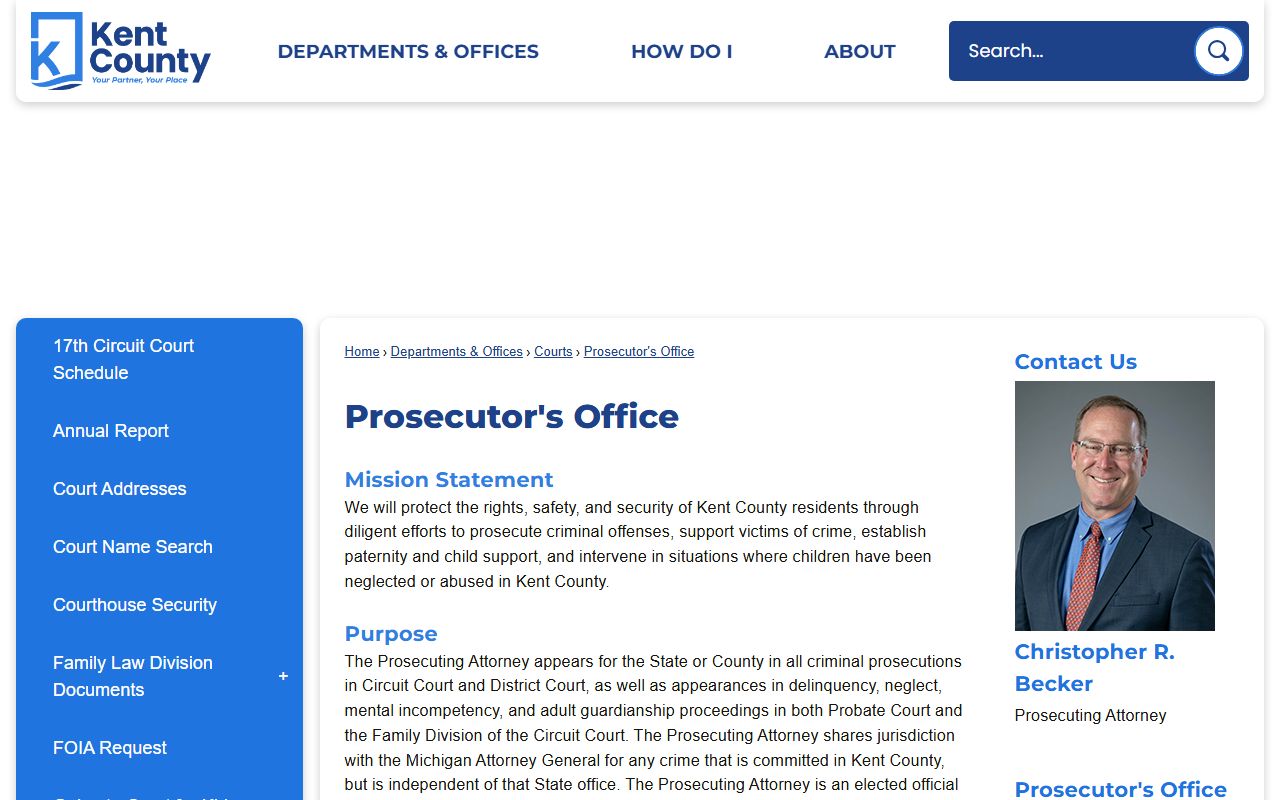
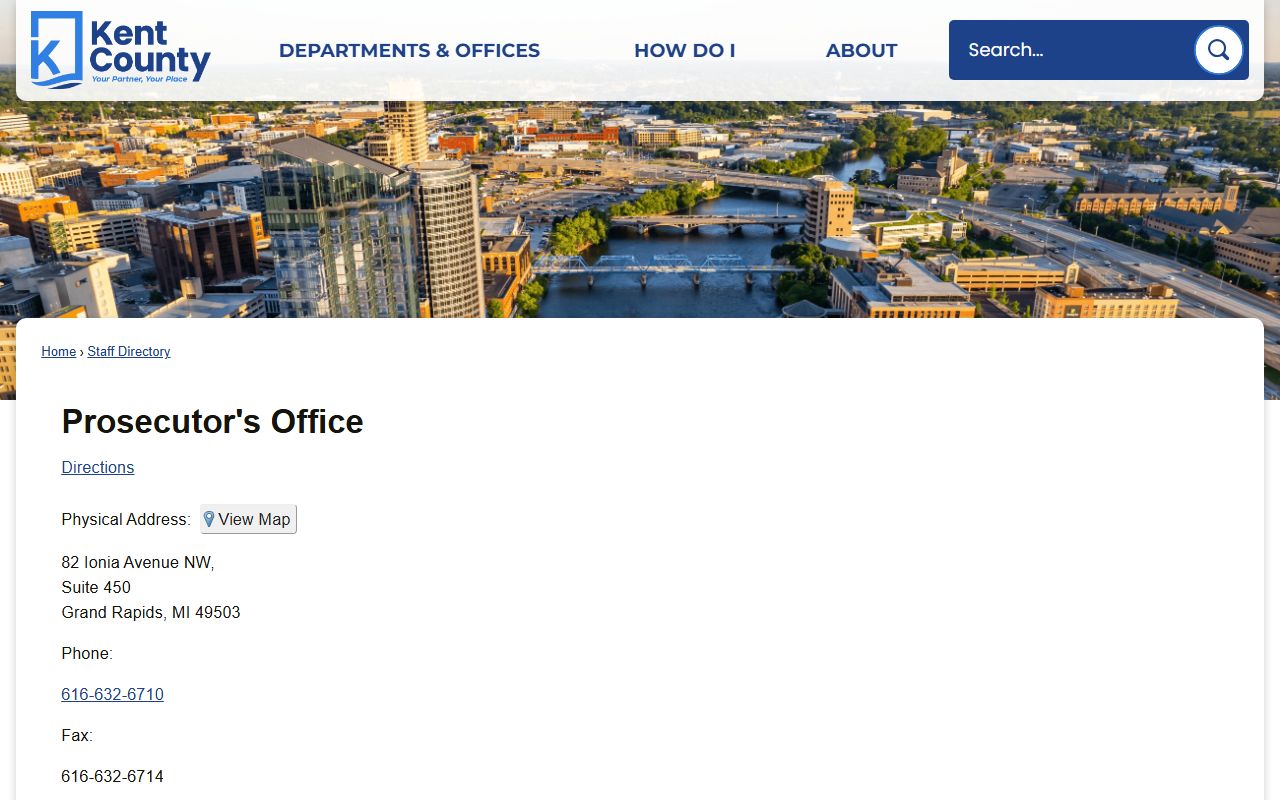
The current prosecuting attorney is Christopher R. Becker, and Monica Janiskee serves as Chief Assistant Prosecutor. The office appears in Circuit Court, District Court, Probate, and Family Division matters, and it splits its work between criminal and appeals, family, and juvenile divisions. The main criminal-and-appeals line is 616-632-6710. Staff assignments and contacts are listed on the prosecutor staff directory.
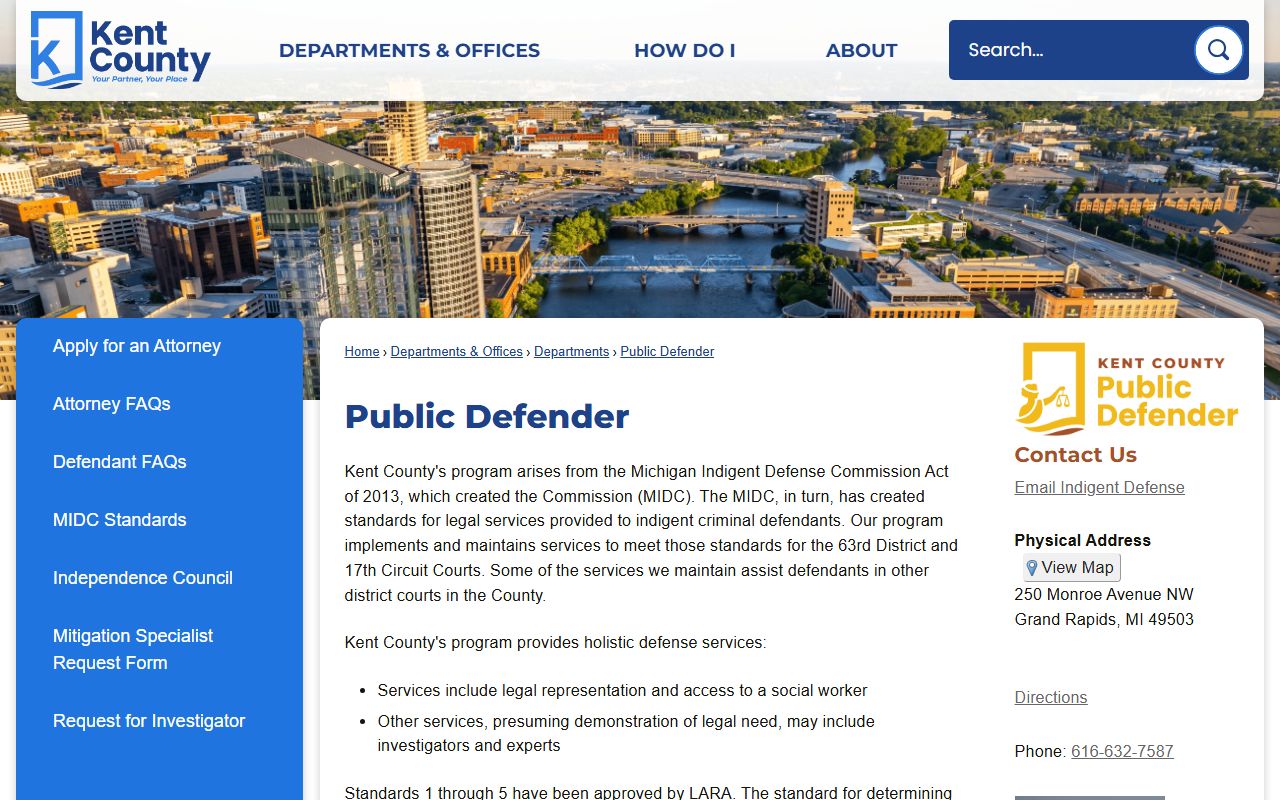
On the defense side, the Kent County Office of the Public Defender, established in September 2024, provides holistic defense that pairs legal representation with a social worker and, when the need is shown, investigators and experts. The office sits at 250 Monroe Avenue NW in Grand Rapids and can be reached at 616-632-7587, and the chief public defender is Julia Kelly. Details appear on the county public defender page.
Defendants who need appointed counsel are not left to guess at the process. The county publishes an online application for a court-appointed attorney, which gives a concrete first step for anyone who qualifies rather than a general referral. Whether a case runs with private, appointed, or public-defender representation, the attorney of record is noted in the case file.
Specialty and Treatment Courts
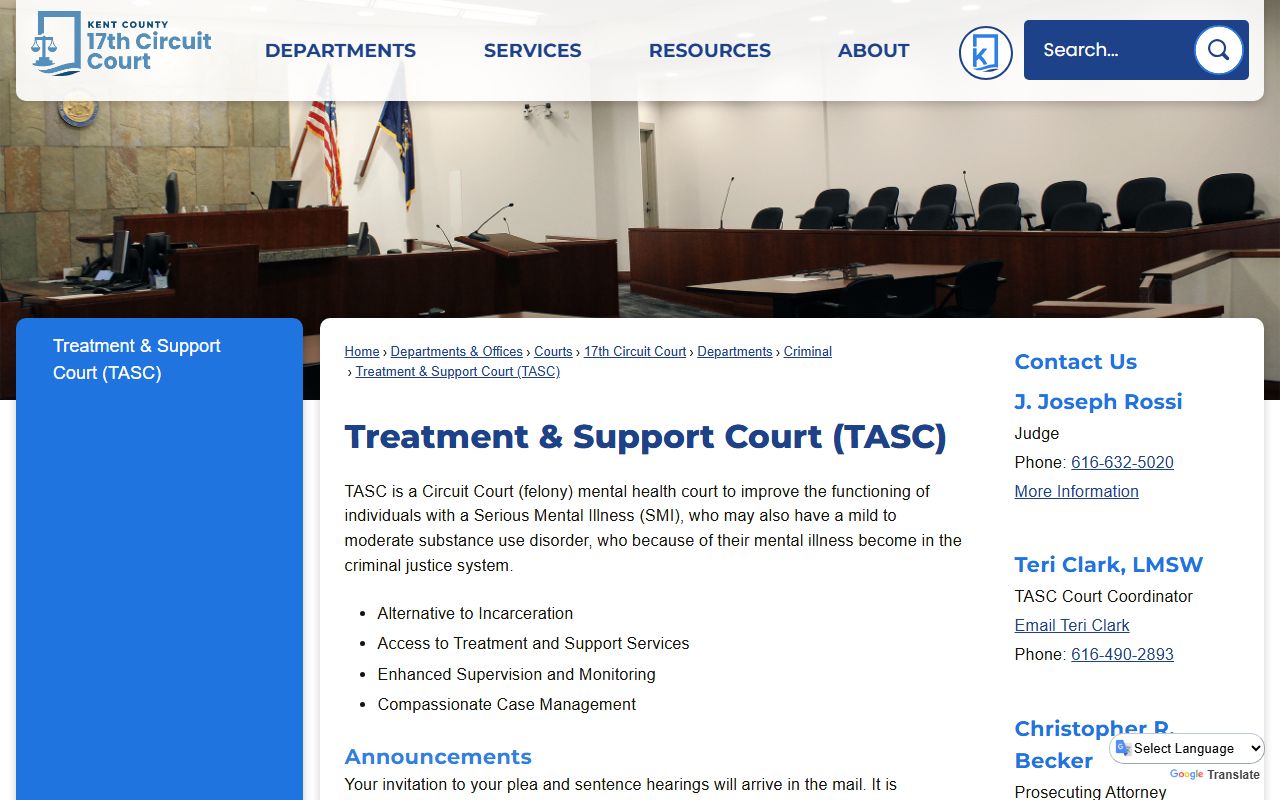
Not every criminal case runs a standard adversarial track. Kent County operates a real network of problem-solving courts that divert eligible defendants into treatment and supervision. These programs explain why some criminal records are handled differently, since a participant's path includes assessment, case management, and regular reporting rather than a single sentencing date. The adult Treatment and Support Court is described on the county TASC page.
The county runs several of these tracks:
- Treatment and Support Court (TASC): an adult problem-solving court led by Judge J. Joseph Rossi for people with co-occurring substance-use and mental-health needs who have entered the criminal system.
- Sobriety Court: serves eligible OWI or OUIL third offenders with assessment, case management, drug testing, and individualized treatment.
- Mental Health Treatment Court: established in the 17th Circuit Court for defendants whose cases are driven by mental illness.
- Recovery Court: started in 2019 by Judge O'Hara for addiction and alcoholism cases.
- Veterans Treatment Court: an active county track supporting justice-involved veterans.
Youth cases have their own version. The Juvenile Treatment and Support Court, led by Judge Deborah McNabb, aims at youth stability, better school performance, and lower future justice-system involvement. It is outlined on the county JTASC page.
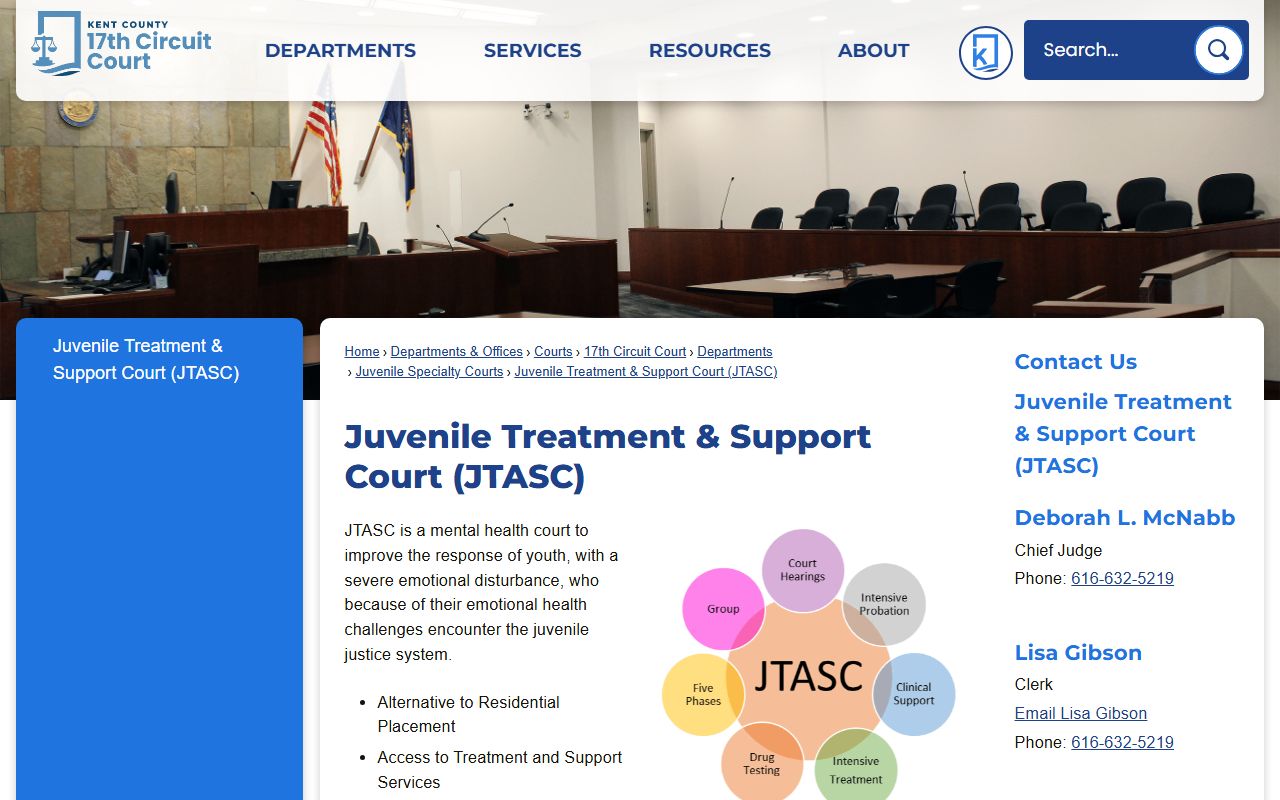
Because juvenile matters are treated separately from adult public files, a JTASC case does not surface in the ordinary criminal-case portals the way an adult felony does.
Public Access to Criminal Court Records
Michigan treats court files as open by default. The practical rule is straightforward: a public case record stays open unless a statute, court rule, or a judge's order makes it nonpublic or sealed. Criminal case files inspected at the clerk's counter are public, and the office states plainly that it cannot give legal advice. County-office and sheriff records follow the state Freedom of Information Act, while court records follow the Michigan court rules first.
Key Statutes:
Michigan Court Rule 8.119 - court records are public unless a rule or statute makes them nonpublic or sealed.
MCL 15.233 - a written FOIA request that describes the record gives access to public records unless an exemption applies.
Michigan Court Rule 1.109 - public filings must omit protected personal identifying information.
Note: circuit case copies run $1 per page and transcripts 30 cents per page, with certification adding $10 to a certified copy.
Sealed vs. Expunged Records
Two different processes can pull a criminal record out of public view, and they are not the same. Sealing restricts access to a file that still exists. Expungement, called setting aside a conviction in Michigan, treats an approved conviction as nonpublic. Michigan's main set-aside statute is MCL 780.621, and county criminal and court pages point residents to Michigan Legal Help for the forms and steps.
| Sealed | Expunged (Set Aside) | |
|---|---|---|
| Visibility | Hidden from public view | Made nonpublic once approved |
| Law Enforcement | Limited access remains | May remain in limited law-enforcement systems |
| How It Happens | By court order | By statutory application to the court |
| Eligibility | Set by rule or judge's order | Convictions that meet the waiting period and statutory limits |
In practice, a person seeking a set-aside files the statutory application, pays the filing fee unless it is waived, waits out any required period after the conviction or sentence, and then asks the court to set the conviction aside. If the court approves, the conviction stops appearing in ordinary public access.
Restricted Criminal Court Records in Kent County
Some criminal matters never appear in the ordinary public view. Juvenile records are usually nonpublic or limited, and the county's juvenile and specialty-court pages keep youth cases apart from adult files. Michigan's juvenile statute, MCL 712A.18e, adds special confidentiality and set-aside rules for youthful offenses. Sealed cases open only to a court order or other authorized access, and expunged convictions drop out of public search once they are set aside.
Other categories stay restricted for their own reasons. Adoption records are handled separately from ordinary case files. Mental-health proceedings are usually more limited because they are filed through Probate Court under statutory confidentiality. Across all public filings, protected personal data such as dates of birth for some parties, Social Security numbers, and account numbers is redacted rather than displayed.
Note: an open case may show limited detail while it is active, so an early docket entry is not the final word on charges or outcome.
Misdemeanor Cases and the 63rd District Court
Misdemeanor files show a different side of the criminal record. The 63rd District Court, at 1950 E Beltline Ave NE in Grand Rapids, publishes one of the clearest criminal-case pages in the county, and its guidance carries over to how these records read. The court's criminal page is posted on the county 63rd District criminal page.
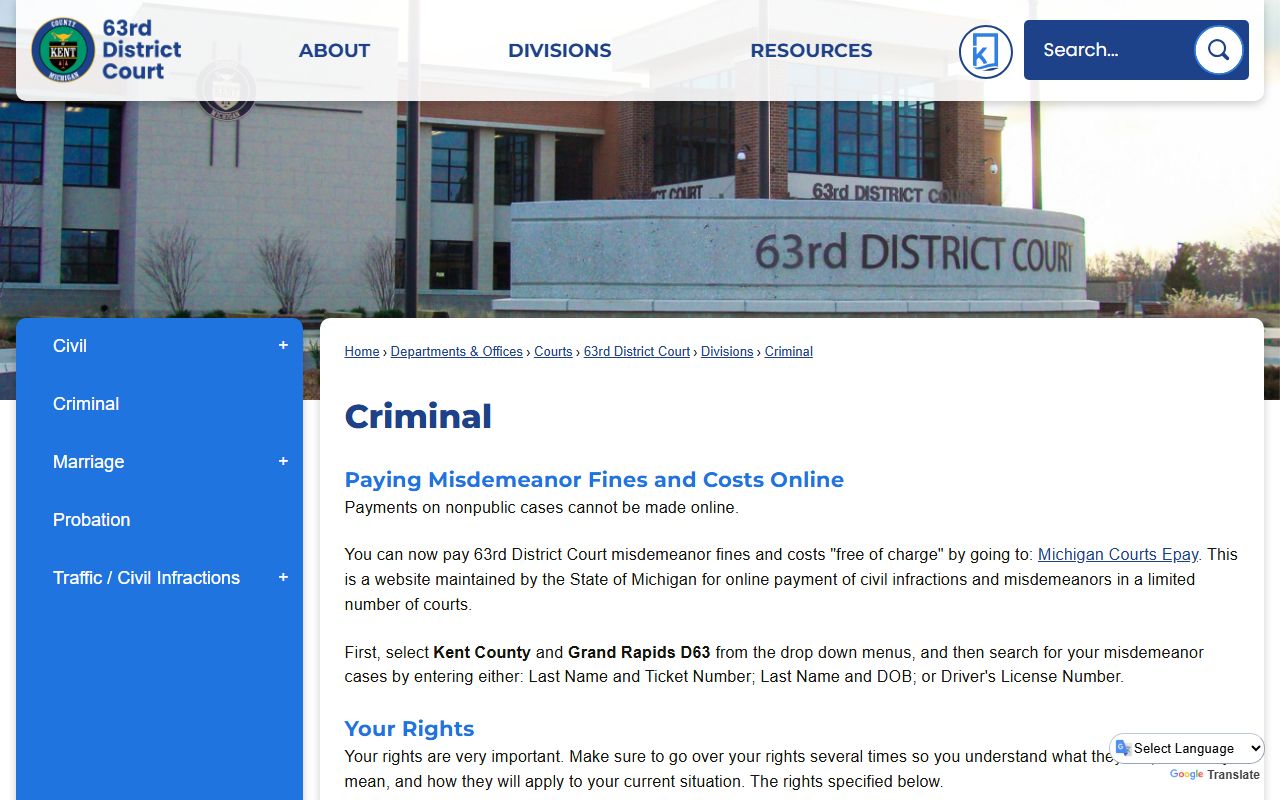
The page lays out the plea options a misdemeanor defendant can enter and the practical booking rule that goes with the more serious charges:
- A defendant may plead guilty, plead no contest, or stand mute at arraignment.
- Charges carrying 93 days or more require booking through the county jail for fingerprints and photos.
- Misdemeanor fines can be paid online through Michigan Courts Epay by selecting Kent County and Grand Rapids D63.
- The court lets users search misdemeanor cases by last name and ticket number, last name and date of birth, or driver's license number.
These keys matter because they are the same data points the file uses even when a public screen does not show every one. A misdemeanor record built from a citation still moves through arraignment, plea, disposition, and sentence, the same arc a felony follows in the 17th Circuit Court, only faster and at the district level.